
Water Line Leak Detection and Repair Under Your Slab
How supply-line leaks are found and fixed without tearing up your whole home.
Water Line Leak Detection: Quick Answers
The short version of this guide to water line leak detection:
- What Does Water Line Leak Detection Find Under Your Slab? Water line leak detection finds breaks in the pressurized supply pipes that carry water through or under your concrete foundation.
- When Should You Call for Water Line Leak Detection? Call Nova at (833) 542-3027 when your meter moves with everything off, when you hear running water that never stops, or when warm spots have appeared on your floors.
- What Are the Signs of a Water Line Leak? Supply-line leaks under a slab produce a recognizable pattern.
What Does Water Line Leak Detection Find Under Your Slab?
Water line leak detection finds breaks in the pressurized supply pipes that carry water through or under your concrete foundation. Most leaks are pinpointed within about 1 to 3 feet using sound, heat, or tracer gas — before any concrete is touched. National estimates as of 2026 put detection at $150-$500, or up to about $600 for complex homes.
Your home has two plumbing systems under the slab, and they fail in different ways. Supply lines (water lines) carry pressurized fresh water to your fixtures. Drain and sewer lines carry wastewater away by gravity. This page covers supply lines — the pressurized ones. Because they are under constant pressure, even a pinhole leak sprays water into the soil around the clock, which is why supply-line leaks announce themselves through water bills, sounds, and warm floor spots. It is one of Nova’s most-requested services.
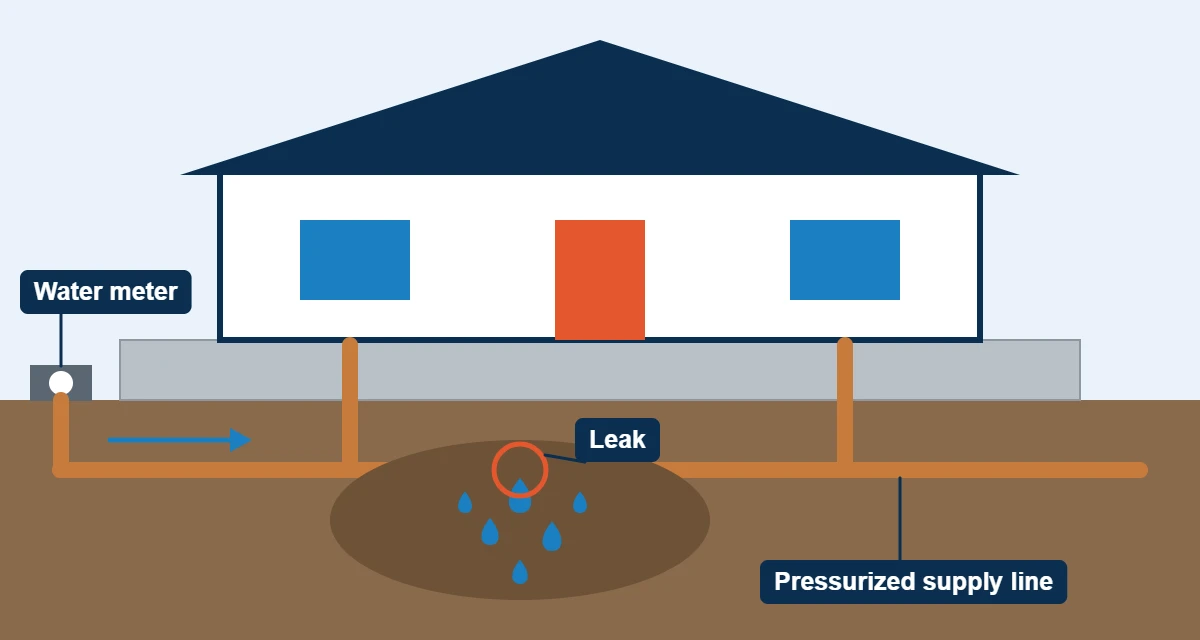
Supply Lines vs. Drain Lines: Why Does the Difference Matter?
Homeowners often lump every under-slab problem together, but the distinction changes the diagnosis, the tools, and the urgency:
- Supply lines are pressurized (typically 40-80 psi in a home). A leak flows continuously, wastes water fast, and can usually be heard with listening equipment. Copper, PEX, and older galvanized pipes are the common materials.
- Drain lines work by gravity, not pressure. Leaks tend to show up as odors, slow drains, or damp soil rather than a spinning meter, and they are confirmed with hydrostatic testing — a pressure test of your drain lines — instead of listening gear.
If your symptom is a high water bill or the sound of running water, you are almost certainly dealing with a supply line. If it is a sewage smell or soggy spots with no bill spike, read our sewer line leak detection page instead. Getting this right first saves you from paying for the wrong test.
What Are the Signs of a Water Line Leak?
Supply-line leaks under a slab produce a recognizable pattern. One sign alone can have other explanations, but two or more together deserve a professional visit:
- A water bill that jumps for no reason. Compare the last few months. A 20 percent or greater increase with no change in household habits is the single most reliable early warning.
- The sound of running water when everything is off. At night, with the house quiet, listen near floors and walls. A faint hiss or rush that never stops often means pressurized water escaping under the slab.
- Warm or hot spots on the floor. A leaking hot water line heats the concrete above it. Walk barefoot over tile or hard flooring — an unexplained warm patch is a strong clue.
- Low water pressure at fixtures. A significant leak bleeds off pressure before water reaches your taps.
- A water meter that moves with everything off. Shut off all faucets and water-using appliances, wait 30 minutes, and recheck the meter. Movement means water is leaving the system somewhere.
- Damp flooring, mildew, or a musty smell. Moisture wicking up through the slab feeds mold along baseboards and under flooring.
The EPA’s WaterSense program notes that the average household’s leaks can waste more than 9,300 gallons of water a year, and 9 percent of homes have leaks wasting 50 gallons or more a day. A supply-line leak under your slab can easily be one of those.
How Does Water Line Leak Detection Pinpoint the Leak?
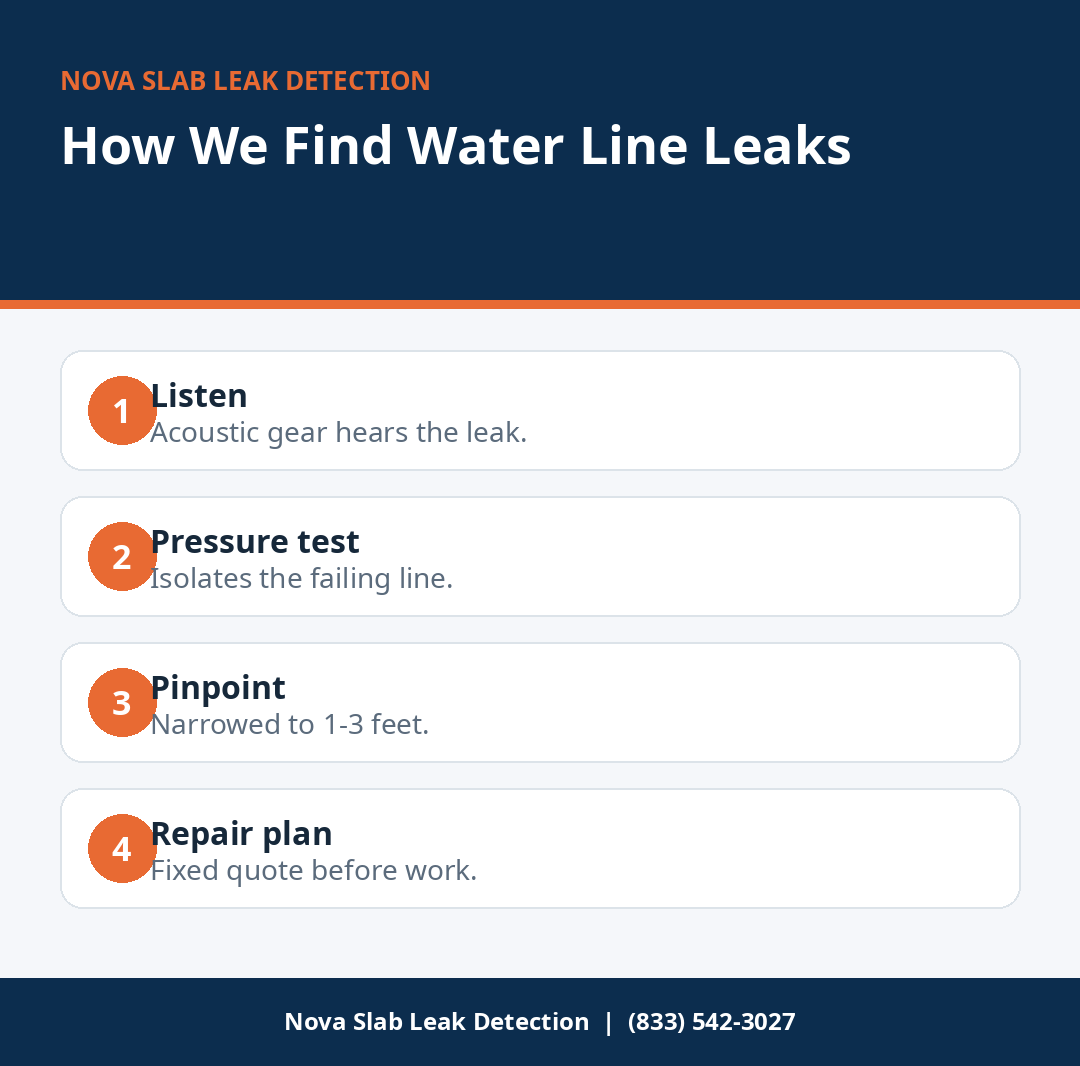
Modern slab leak detection is non-invasive. The technician our team sends will typically combine several of these methods rather than relying on just one:
- Acoustic listening. Highly sensitive ground microphones and headphones pick up the sound of pressurized water escaping through concrete. This is the workhorse method for supply lines.
- Thermal imaging. An infrared camera shows temperature differences on the floor surface, which is especially effective for hot water line leaks.
- Tracer gas. The line is drained and filled with a safe hydrogen-nitrogen mix; the gas escapes at the break and is detected at the surface, even through flooring.
- Pressure and isolation testing. Individual lines are pressurized and monitored. A line that will not hold pressure has the leak, which narrows the search before listening begins.
A water line leak detection visit usually takes 1 to 3 hours, and detection usually pinpoints the leak within about 1 to 3 feet. Honest limit: no method can guarantee the exact depth of the pipe or the precise size of the break without opening the slab — what detection gives you is a tight target area so the repair opens as little concrete as possible.
What Are the Repair Options After Water Line Leak Detection?
After detection, our team will recommend one of the standard repair approaches. National estimates as of 2026:
| Repair option | What happens | National cost estimate (2026) |
|---|---|---|
| Spot repair | Open the slab at the marked location, replace the damaged section | $1,500-$4,500 |
| Reroute | Abandon the buried line, run new pipe through walls or attic | $3,500-$7,000 |
| Tunneling | Dig beneath the slab from outside to reach the pipe | $3,500-$8,000 |
Full details — including how the technician chooses between them and what happens to your flooring — are on our slab leak repair page. If leaks keep recurring, the conversation shifts to whole-home repiping, which replaces the aging system instead of patching it again.
Hot vs. Cold Water Line Leaks: What Is the Difference?
It matters which line is leaking, because the symptoms and the stakes differ:
- Hot water line leaks reveal themselves faster. Warm floor spots, higher energy bills (your water heater runs constantly to replace lost hot water), and quicker mold growth in the warm, damp environment. Thermal imaging finds these especially well.
- Cold water line leaks are sneakier. No warm spots, so the first clue is usually the water bill or the meter test. They waste just as much water, and the constant moisture still erodes soil under the slab.
Either way, the water line leak detection process is the same, and the repair options are the same. The main practical difference: with a hot water line leak, many homeowners also notice the water heater cycling far more than usual — worth mentioning when you describe symptoms.
What Can Water Line Leak Detection Not Guarantee?
Straight talk about limits, so you know what to expect:
- Detection pinpoints location, not the full extent of pipe damage. The visible break may be one of several weak spots in an old line.
- It cannot see through every material equally. Thick stone flooring, radiant heat tubing, and post-tension cables can complicate readings.
- A “no leak found” result on one visit is not a lifetime warranty. Pipes continue to age, and a new leak can develop later.
- Detection tells you where the leak is, not what caused it. The cause — corrosion, soil movement, abrasion, high pressure — is inferred from the pipe’s condition and your home’s history.
A reputable technician explains these limits before starting. If someone promises perfect accuracy or pressures you to approve a repair before testing is complete, get a second opinion.

What Can You Check Yourself Before Water Line Leak Detection?
These checks take about 15 minutes and give our team a head start:
- The meter test. Turn off everything that uses water — faucets, dishwasher, washing machine, irrigation. Note the meter reading, wait 30 minutes without using any water, and read it again. Any movement means a leak.
- The hot water test. Turn off your water heater’s supply for a couple of hours (mark the valve position first). If the hissing sound stops, the leak is likely on the hot side.
- The bill audit. Pull 6 months of water bills. A steady climb or a sudden step up, with no new occupants or habits, points to a growing leak.
- The barefoot walk. On a cool morning, walk barefoot over hard floors and note any warm patches and their locations. Sketch a rough map — technicians love this.
- The perimeter look. Walk around your home’s foundation. Unusually lush grass strips, soft soil, or water seeping at the slab edge can mark where escaping water surfaces.
Write down what you find. When you call, you will sound like someone who has done their homework, and the visit will go faster.
When Should You Call for Water Line Leak Detection?
Call Nova at (833) 542-3027 when your meter moves with everything off, when you hear running water that never stops, or when warm spots have appeared on your floors. The line is open 24 hours a day, 7 days a week, the call is free, and Nova will send a technician who serves your area. The same Nova team that finds the leak explains your options and the price before any work begins. If anything about the visit is not right, our satisfaction guarantee means you call Nova and Nova works with our team on your behalf.
Water Line Leak Detection: Frequently Asked Questions
Services Related to Water Line Leak Detection
These pages cover what comes before and after water line leak detection.
- Whole Home Repiping: When patching old pipes stops making sense, a full repipe ends the cycle.
- Commercial Slab Leak Detection: Keep your business running while a technician finds the leak — often after hours.
- Emergency Leak Detection: Water where it should not be? Here is exactly what to do in the next 10 minutes.
- Slab Leak Detection: How non-invasive detection finds a leak under concrete, with methods, cost and accuracy.
- All Slab Leak Services: Every detection and repair service, compared in one place.
Need Water Line Leak Detection? Call Nova Today
Call any time, day or night. Tell us your ZIP code and what you are noticing, and we will book your visit for water line leak detection.