
Acoustic Leak Detection: Finding Slab Leaks by Sound
Sensitive microphones hear what your ears cannot — pressurized water escaping under your slab.
Acoustic Leak Detection: Quick Answers
The short version of this guide to acoustic leak detection:
- How Does Acoustic Leak Detection Work? Acoustic leak detection finds hidden pipe leaks by listening for them.
- What Equipment Does Acoustic Leak Detection Use? You do not need to operate any of this — the technician brings it — but knowing what you are looking at helps you understand the visit.
- What Happens During an Acoustic Leak Detection Visit? Preparation. The technician will ask you to turn off anything noisy if possible — dishwashers, washing machines, loud TVs.
How Does Acoustic Leak Detection Work?
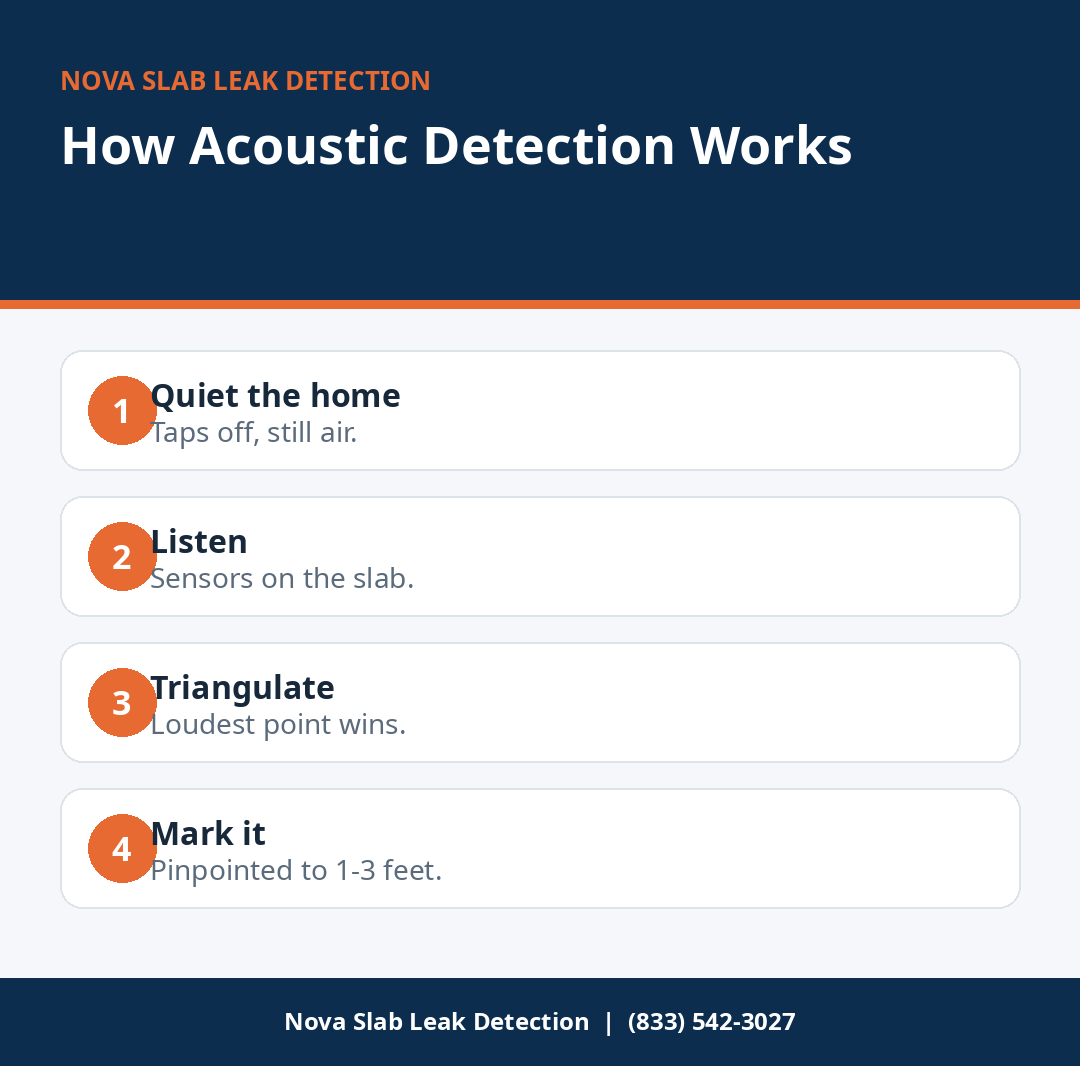
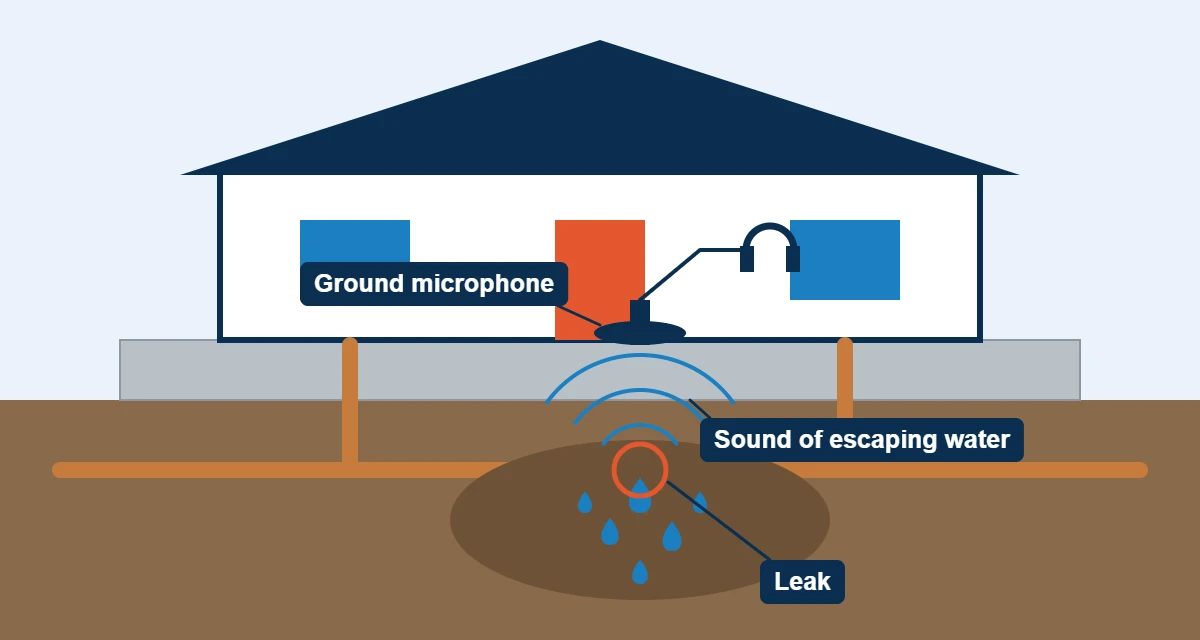
Acoustic leak detection finds hidden pipe leaks by listening for them. Pressurized water escaping through a crack makes a distinct hissing sound, and sensitive ground microphones can hear it through your concrete slab. The technician moves the sensor across the floor — the sound gets louder as they get closer to the leak.
Here is the simple version of the physics. Water inside your supply pipes is under pressure, usually 40 to 80 PSI in a home. When it escapes through a pinhole or crack, it sprays into the soil under the slab. That spray vibrates the pipe, the soil, and the concrete, and those vibrations travel up to the floor where the microphone picks them up.
The human ear cannot hear most of this — the sound is faint and buried under normal household noise. That is why the equipment matters: a ground microphone feeds an electronic amplifier that boosts the leak sound while filtering background noise.
The same Nova team that finds the leak explains your options and the price before any work begins. When you call (833) 542-3027, we send a technician. Calling Nova is free.
What Equipment Does Acoustic Leak Detection Use?
You do not need to operate any of this — the technician brings it — but knowing what you are looking at helps you understand the visit.
Ground microphone. A disc-shaped sensor, roughly the size of a hockey puck, placed flat on the floor. It converts tiny vibrations in the concrete into an electrical signal, which the technician reads as sound.
Electronic amplifier. A small control unit that boosts the microphone’s signal hundreds of times and filters frequencies. Leak sounds sit in a specific frequency band, so filtering out background noise — refrigerators, traffic, HVAC hum — makes the leak stand out.
Headphones. Noise-isolating headphones let the technician hear subtle changes in the leak’s tone while moving the sensor. An experienced ear can tell a supply-line leak’s steady hiss apart from normal pipe noise.
The whole setup is non-invasive. Nothing gets cut, drilled, or opened during the listening phase.
Acoustic vs. Thermal vs. Tracer Gas: Which Method Is Best When?
No single method is best for every leak. Pros choose based on the symptoms:
| Acoustic listening | Thermal imaging | Tracer gas | |
|---|---|---|---|
| What it detects | Sound of pressurized water escaping | Heat patterns from hot water leaks | Gas escaping at the leak point |
| Best for | Supply-line leaks with good pressure | Hot water line leaks under flooring | Tiny leaks, or leaks acoustic cannot isolate |
| Works on cold lines? | Yes, if pressure is adequate | Poorly — no heat signature | Yes |
| Works through tile? | Yes | Yes, with clear line of sight | Yes |
| Main limitation | Background noise; very small leaks are quiet | Only sees temperature differences | Takes longer; gas must be introduced into the line |
| Typical use | First method tried in most visits | Paired with acoustic for hot lines | Follow-up when acoustic is inconclusive |
In practice, a good technician rarely relies on one method alone — a typical visit starts with acoustic listening, then confirms with thermal imaging or a pressure test. See thermal imaging leak detection and tracer gas leak detection.
What Happens During an Acoustic Leak Detection Visit?
Preparation. The technician will ask you to turn off anything noisy if possible — dishwashers, washing machines, loud TVs. They will also ask about your symptoms: where you hear water, where the floor feels warm, when the bill jumped. Your answers tell them where to start.
The listening survey. Wearing headphones, the tech places the ground microphone on the floor and moves it in a grid, often starting near the water heater or the main line entry. They mark the floor where the sound is loudest. This usually takes 30 to 90 minutes.
Narrowing it down. Once the loudest point is found, the tech listens from multiple angles and may confirm with a second method. Detection usually pinpoints a leak within about 1 to 3 feet, which keeps the repair excavation small.
The verdict. You get a straight answer: leak found at a marked location, no leak found, or inconclusive with a recommended next step. A visit usually takes 1 to 3 hours total. Stay available for questions, but let the technician concentrate — listening for faint sounds requires focus.
What Can You Check Yourself Before Acoustic Leak Detection?
Before you book, these checks help confirm that acoustic detection is the right next step:
- The meter test. Turn off every faucet and water-using appliance, then watch your water meter for 15 minutes. If it moves, you have a pressurized leak — exactly what acoustic equipment is designed to find.
- The quiet-house listen. Late at night, turn everything off and put your ear to the floor in the quietest room. A faint hiss or rushing sound is worth noting, including the location.
- The hot-spot check. Walk barefoot across tile or hard floors. A warm patch with no heating vent nearby suggests a hot water line leak.
- The bill check. Pull 12 months of water bills. A sudden, sustained jump with no change in household habits is the most reliable early warning sign there is.
Bring your notes to the visit. They tell the technician where to start listening, which shortens the appointment.
What Are the Limits of Acoustic Leak Detection?
Acoustic detection is the industry workhorse, but it has real limits:
- It cannot guarantee the exact depth of the pipe without opening the slab. It finds the horizontal location; depth is estimated from building plans or experience.
- Very small leaks are quiet. A pinhole leak at low pressure may not make enough sound to isolate in a noisy home. That is when tracer gas or pressure testing takes over.
- Background noise interferes. Homes near busy roads or with loud HVAC systems are harder to survey, so the technician may schedule during quieter hours.
- It cannot see the pipe’s condition. Acoustic finds the leak point, not the health of your plumbing — if pipes are old and failing in several spots, the technician should say so.
- Drain lines are a different job. Acoustic works on pressurized supply lines; drain-line leaks under the slab need camera inspection or hydrostatic testing — see video pipe inspection.
A trustworthy pro explains these limits before starting, not after the equipment comes up empty. If something is not right with the service you receive, our satisfaction guarantee applies — call Nova and we will work with our team.

When Should You Call for Acoustic Leak Detection?
Call (833) 542-3027 — open 24 hours a day, 7 days a week — when:
- Your meter test shows water moving with everything off. That is the clearest signal you need professional detection.
- You hear running water inside walls or floors when nothing is on.
- A previous visit was inconclusive and you want our team with full detection equipment.
When you call, mention your symptoms and what your self-checks found. For the full range of detection options, start at slab leak detection.
Acoustic Leak Detection: Frequently Asked Questions
Services Related to Acoustic Leak Detection
These pages cover what comes before and after acoustic leak detection.
- Hydrostatic Testing: Simple water and pressure tests prove whether a leak exists — before anyone touches your concrete.
- Moisture Mapping: See exactly where the water went — before you pay to open the slab.
- Thermal Imaging Leak Detection: Infrared cameras reveal hidden hot-water leaks beneath your slab — before any concrete is cut.
- Slab Leak Detection: How non-invasive detection finds a leak under concrete, with methods, cost and accuracy.
- Slab Leak Repair: Four proven ways to fix a leak under your slab — and how to pick the right one.
For general facts on household leaks and water waste, see the EPA WaterSense guide to fixing leaks.
Need Acoustic Leak Detection? Call Nova Today
Call any time, day or night. Tell us your ZIP code and what you are noticing, and we will book your visit.