
Commercial Slab Leak Detection for Businesses
Keep your business running while a technician finds the leak — often after hours.
Commercial Slab Leak Detection: Quick Answers
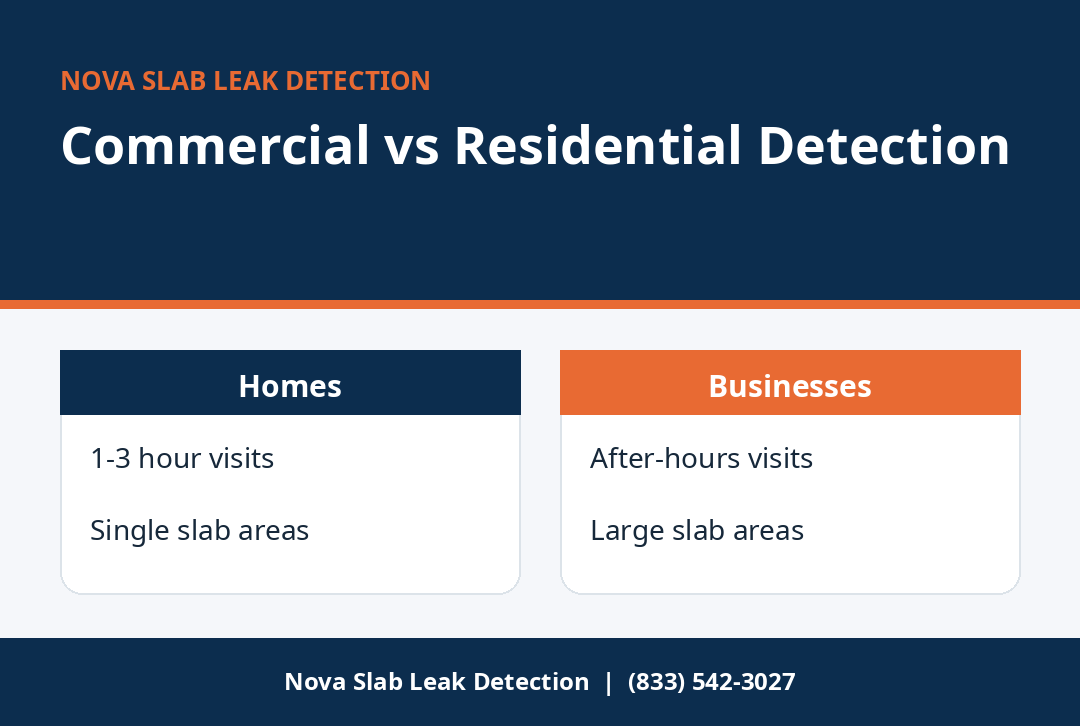
The short version of this guide to commercial slab leak detection:
- What Does Commercial Slab Leak Detection Cover? Commercial slab leak detection finds hidden pipe leaks under the concrete slabs of business properties.
- How Much Does Commercial Slab Leak Detection Cost? National estimates as of 2026 for detection work: $150-$500, or up to about $600 for complex properties — the same ranges as residential slab leak detection.
- Can Commercial Slab Leak Detection Be Done After Hours? For most businesses, the best time for detection work is when customers and staff are gone.
What Does Commercial Slab Leak Detection Cover?
Commercial slab leak detection finds hidden pipe leaks under the concrete slabs of business properties. It locates the leak with non-invasive equipment before any concrete is opened, so your business loses as little time as possible. The same proven methods as residential detection are used — acoustic, thermal, tracer gas, pressure testing — scaled for larger buildings.
Nova’s own technicians carry out the work and give you the price before it starts. When you call (833) 542-3027, we send a technician experienced in commercial work. Our team performs the commercial slab leak detection, sets the price, and works around your schedule. Calling Nova is free, and our line is open 24 hours a day, 7 days a week. See all our services.
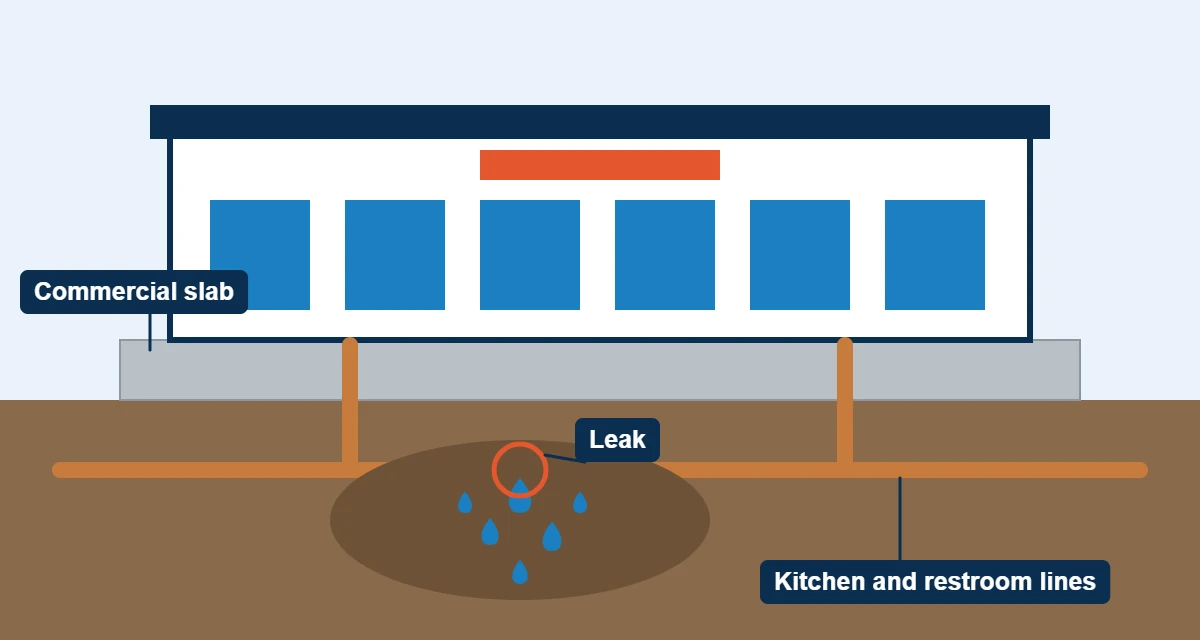
Which Businesses Need Commercial Slab Leak Detection Most?
Any commercial building on a concrete slab can develop a hidden leak, but some businesses feel the pain faster:
Restaurants and food service. A leak under the kitchen slab can shut down food prep areas, and health inspectors do not wait. Moisture also creates slip hazards and sanitation problems. Fast, discreet detection matters more here than almost anywhere.
Hotels and hospitality. A leak in a ground-floor slab can affect lobbies, guest rooms, and common areas. Guests notice damp smells and stained flooring immediately, and reviews follow. Detection that happens quietly, ideally overnight, protects your reputation.
Offices and professional buildings. Leaks under office slabs disrupt tenants, damage flooring and furniture, and trigger complaints to property management. Multi-tenant buildings add coordination work: the technician may need access to several suites.
Retail stores. Water pushing up through a sales floor damages inventory, creates liability from slip-and-fall risks, and forces partial closures during your busiest hours. After-hours detection avoids all of that.
Warehouses and industrial. Large slabs, heavy equipment, and long pipe runs make leaks harder to find and more expensive to ignore. Water under a warehouse slab can also undermine the concrete that supports racking and machinery, which becomes a structural question, not just a plumbing one.
Multi-site portfolios. If you manage several locations, one call can start the process for whichever site has the problem, and the written detection report gives you consistent documentation across properties.
How Is Commercial Slab Leak Detection Different From Residential?
The methods are the same, but the job is bigger and more complex:
| Residential | Commercial | |
|---|---|---|
| Building size | 1,000-3,000 sq ft typical | 5,000-100,000+ sq ft |
| Pipe systems | One water heater, simple runs | Multiple zones, boilers, recirculation loops, grease lines |
| Access | Homeowner opens the door | Tenant coordination, keys, security, multiple suites |
| Scheduling | Daytime usually fine | Often after hours to avoid disrupting business |
| Documentation | Verbal or simple written findings | Formal written reports for insurance, landlords, and records |
| Decision makers | Homeowner decides on the spot | May need manager, owner, or corporate approval |
| Downtime cost | Inconvenience | Lost revenue per hour the business is disrupted |
Because of this complexity, always tell our team it is a commercial property when you call. The equipment, the crew size, and the scheduling are all different, and a company that only does houses may not be the right fit.
Can Commercial Slab Leak Detection Be Done After Hours?
For most businesses, the best time for detection work is when customers and staff are gone. Here is how to keep disruption near zero:
- Book nights or early mornings. Many commercial-capable companies offer after-hours detection. The building is empty, the technician can work faster, and no customer ever sees a thing.
- Stage the work by zone. For large buildings, the technician can check one section per visit — the kitchen wing on Monday night, the lobby on Tuesday night — so no area is ever fully offline.
- Coordinate access in advance. Provide keys, alarm codes, and a contact who can answer questions during the visit. Every minute the technician waits at a locked door is a minute you are paying for.
- Warn tenants or staff briefly. A one-line notice (“plumbing inspection Tuesday night, no disruption expected”) prevents alarmed phone calls.
- Plan for the repair separately. Detection is quiet and non-invasive. The actual repair may need louder work, so schedule it with the same low-disruption approach.
When you call Nova at (833) 542-3027, mention that you need after-hours service and describe the building type. We will send a technician who handles commercial scheduling.
What Documentation Does Your Business Get?
Commercial jobs live and die by paperwork. A proper detection visit should leave you with:
A written findings report. Where the leak is (usually pinpointed within about 1 to 3 feet), which line is affected, the method used to find it, and photos of the test points. This is your record for insurance, landlords, and corporate files.
Photos and readings. Dated photos of moisture damage, meter readings, and thermal images if used. These support insurance claims and protect you if a landlord or tenant disputes the timeline.
A clear scope for repair. The report should separate what was found from what is recommended, with the repair options explained: spot repair, rerouting the line, or repiping. We confirm the final price on site — get it in writing.
Chain-of-custody for multi-party situations. If a landlord, tenant, and insurer are all involved, one professional report that everyone can reference prevents the “he said, she said” problem.
Keep every document for at least as long as your insurance policy requires, and longer if the building is leased. If something is not right with the service, our satisfaction guarantee applies: call Nova and we will work with our team on the issue.
What Can You Check Yourself Before Commercial Slab Leak Detection?
Before the technician arrives, a 20-minute walkthrough gives you useful information:
- Check the water meter. With everything off — ice machines, dishwashers, irrigation — watch the meter for 10 minutes. Movement means water is escaping somewhere in the building.
- Walk the slab areas. Look for damp spots, buckling tile, or flooring that feels warm in one area. In kitchens, pull back floor mats and look underneath.
- Sniff for mustiness. Storage rooms, mop closets, and rarely opened areas reveal hidden dampness first.
- Review recent utility bills. A jump of 20 percent or more with no change in operations is a classic leak signal. The EPA notes that the average household’s leaks can waste more than 9,300 gallons of water a year, and 9 percent of homes have leaks wasting 50 gallons or more a day — and commercial buildings waste far more at scale. Source: EPA WaterSense.
- Ask staff. Cooks, cleaners, and maintenance staff notice sounds of running water, warm floors, and damp smells long before managers do. Ask them directly.
Write down what you find, including dates. Hand it to the technician on arrival — it focuses the visit and shortens the billable time.
How Much Does Commercial Slab Leak Detection Cost?
National estimates as of 2026 for detection work: $150-$500, or up to about $600 for complex properties — the same ranges as residential slab leak detection. Commercial buildings often land at the higher end because of size, access coordination, and after-hours scheduling. We confirm the final price on site, so ask for a written quote that separates the detection fee from any after-hours surcharge.
If commercial slab leak detection finds a leak that needs repair, the same national estimates apply: spot repair $1,500-$4,500, reroute $3,500-$7,000, tunneling $3,500-$8,000, epoxy lining $3,000-$6,000, and whole-home — or in this case whole-building — repipe $4,500-$15,000, though large commercial repipes can exceed that range depending on the building.
Budget honestly. For businesses, the detection fee is almost always the smallest number involved. The expensive part is downtime and water damage. A $400 detection visit that finds a leak on a Tuesday night is vastly cheaper than a flooded dining room on a Saturday. Price the urgency, not just the visit.
When Should You Call for Commercial Slab Leak Detection?
Call (833) 542-3027 — open 24/7 — when:
- You have active water intrusion in any commercial space. Do not wait for business hours if water is spreading. For burst-pipe situations, see emergency leak detection.
- A utility bill jumped and your own meter check confirms unexplained usage.
- Staff report warm floors, damp smells, or the sound of running water with everything off.
- You manage multiple properties and want one point of contact to start the process at the affected site.
- You need after-hours or weekend scheduling to avoid disrupting operations.
- An insurer, landlord, or health inspector wants professional documentation of a suspected leak.
When you call, have ready: the building type and approximate size, the symptoms and when they started, your preferred service window (nights, weekends), and who can grant the technician access. We will send a technician experienced in commercial work.
Commercial Slab Leak Detection: Frequently Asked Questions
Services Related to Commercial Slab Leak Detection
These pages cover what comes before and after commercial slab leak detection.
- Emergency Leak Detection: Water where it should not be? Here is exactly what to do in the next 10 minutes.
- Foundation Moisture Assessment: Find hidden moisture in and around your foundation before it turns into costly damage.
- Sewer Line Leak Detection: Drain leaks hide under concrete too. Here’s how pros find and fix them.
- Slab Leak Detection: How non-invasive detection finds a leak under concrete, with methods, cost and accuracy.
- All Slab Leak Services: Every detection and repair service, compared in one place.
Need Commercial Slab Leak Detection? Call Nova Today
Call any time, day or night. Tell us your ZIP code and what you are noticing, and we will book your visit for commercial slab leak detection.