
Emergency Leak Detection: What to Do Right Now
Water where it should not be? Here is exactly what to do in the next 10 minutes.
Emergency Leak Detection: Quick Answers
The short version of this guide to emergency leak detection:
- When Do You Need Emergency Leak Detection? Emergency leak detection is for sudden, active water trouble you cannot control: a burst pipe under the slab, water flooding across your floors, or water pouring where it should not.
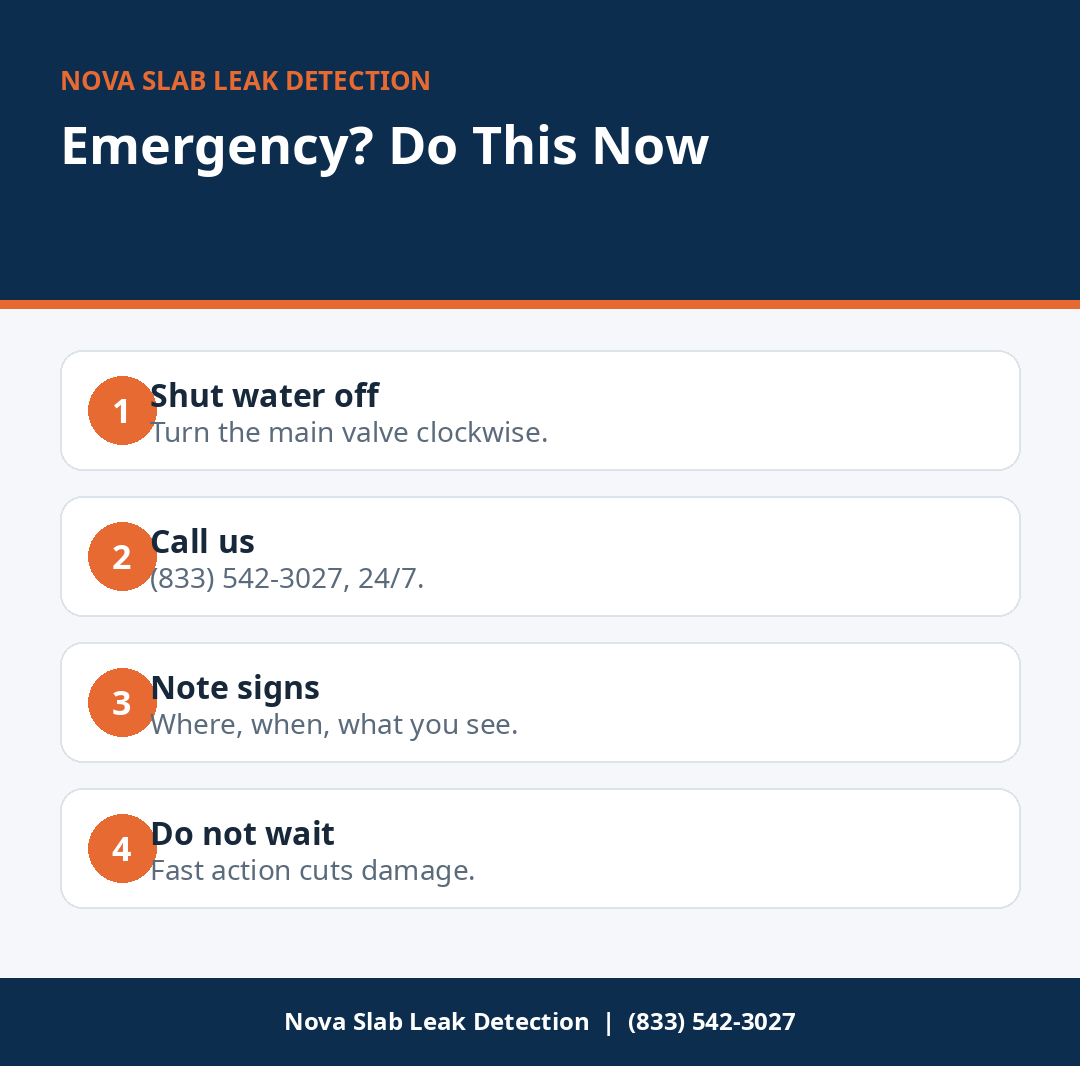
- What Should You Do Right Now? 5 Steps Do these in order. They take about 10 minutes and can save you thousands of dollars in damage.
- How Do You Find Your Main Water Shutoff Valve? Most people have never touched their shutoff valve until an emergency.
When Do You Need Emergency Leak Detection?
Emergency leak detection is for sudden, active water trouble you cannot control: a burst pipe under the slab, water flooding across your floors, or water pouring where it should not. If water is damaging your home right now, treat it as an emergency. Slow signs like a slightly higher bill can usually wait for a daytime visit.
Emergencies do not follow business hours. Pipes burst at 2 a.m., water heaters fail on holidays, and frozen lines let go on the coldest night of the year. That is why Nova’s phone line is open 24 hours a day, 7 days a week. When you call (833) 542-3027, we send a technician who handles urgent calls in your area. Calling Nova is free.
This page tells you what to do in the first 10 minutes, what not to do, and what happens when the technician arrives. See all our services.
What Should You Do Right Now? 5 Steps
Do these in order. They take about 10 minutes and can save you thousands of dollars in damage.
- Stay calm and keep people safe. Keep children and pets away from standing water, especially near outlets, appliances, or the electrical panel. If water is near anything electrical, do not touch it.
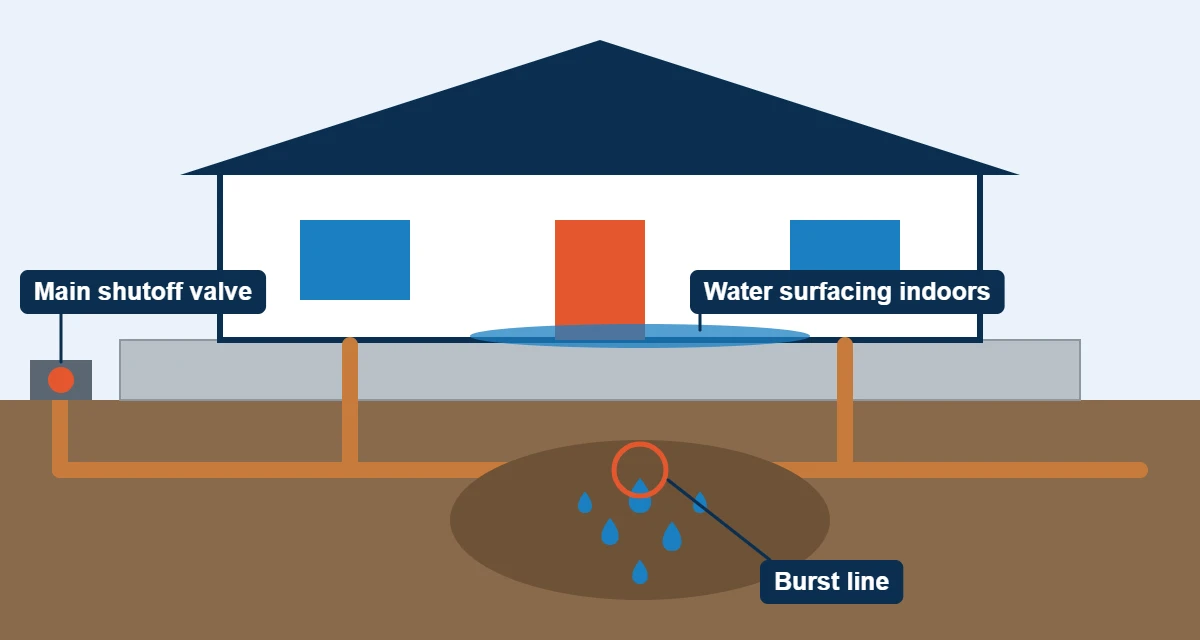
- Turn off the main water supply. This is the single most important step. Find your main shutoff valve (see the next section) and turn it clockwise until it stops. This halts the flow and buys you time.
- Turn off the water heater. If you shut off the main supply, switch your water heater to its pilot or vacation setting, or turn off its breaker. A heater that keeps firing with no water inside can be damaged.
- Document the damage. Take photos and short videos of the water, the affected rooms, and any damaged belongings before you start cleaning. Your insurer will want this. Check your policy later about what is covered.
- Call for help. Call Nova at (833) 542-3027. Describe what is happening: where the water is, whether you shut off the main, and whether it is still spreading. We will send a technician who takes emergency leak detection calls.
Do not wait until morning to see if it gets better. Pressurized leaks do not fix themselves, and every hour of standing water increases the repair bill.
How Do You Find Your Main Water Shutoff Valve?
Most people have never touched their shutoff valve until an emergency. Learn where yours is today, before you need it.
Common locations. In warm climates, look near the water meter at the street, in a ground-level box marked “water.” In colder climates, look in the basement or crawlspace where the main line enters the house, often near the water heater or under the kitchen sink. In apartments and condos, there may be a shutoff for your unit plus a building main.
How it works. Most valves are either a round wheel handle (turn clockwise to close) or a lever handle (turn it so it sits across the pipe, not in line with it). Turn firmly but do not force a stuck valve with tools that could break it.
Test it once a year. Close it, open a faucet to confirm the water stops, then reopen it. Valves that sit untouched for years can seize. If yours will not budge, have a plumber replace it during a non-emergency visit. That is a cheap fix that pays for itself the night you need it.
If you cannot find it or it will not turn. Call Nova at (833) 542-3027 and say so. The technician can talk you through it or come out. As a last resort, your water utility often has an emergency line that can shut off water at the street meter.
What Should You Not Do in a Water Emergency?
Panic leads to mistakes. Avoid these:
- Do not ignore it until morning. A pressurized supply leak can release hundreds of gallons overnight. The EPA notes that the average household’s leaks can waste more than 9,300 gallons of water a year, and 9 percent of homes have leaks wasting 50 gallons or more a day. A burst pipe wastes far more, far faster. Source: EPA WaterSense.
- Do not tear up floors or walls yourself. You cannot see where the leak is, and opening the slab without locating it first usually means destroying the wrong area. Detection equipment pinpoints the leak before any concrete is touched.
- Do not use electrical devices in standing water. No wet vacuums plugged into wet outlets, no fans sitting in puddles. Unplug what you safely can from dry areas.
- Do not pour drain cleaner or sealants into the system. Chemical fixes do not reach leaks under concrete and can damage pipes further.
- Do not hire the first truck that shows up without checking. Even in an emergency, ask who the company is and confirm they will give you a written price before work starts. The FTC’s advice on avoiding home improvement scams applies at midnight just as much as at noon.
Is It an Emergency, or Can It Wait?
Use this table to decide how fast to act:
| Situation | Act now | Can wait for daytime |
|---|---|---|
| Water actively flooding floors or rooms | Yes — shut off main, call now | |
| Burst pipe with water you cannot stop | Yes — shut off main, call now | |
| No water at all from any faucet | Yes — could be a major break | |
| Sewage backing up into the home | Yes — health hazard, call now | |
| Warm spot on the floor, no visible water | Yes — book slab leak detection soon | |
| Slightly higher water bill, everything looks dry | Yes — monitor and schedule a visit | |
| Faint sound of running water, no damage visible | Yes — schedule within days, not weeks |
When in doubt, treat it as urgent. A phone call costs nothing, and the technician can tell you whether your situation needs a night visit or a morning appointment.
How Does Nova’s 24/7 Line Get You Emergency Leak Detection Tonight?
Our technicians do the work, explain what they find, and give you the price up front. We do not perform plumbing work ourselves. Here is what happens when you call (833) 542-3027 at any hour:
- You describe the problem. Tell us where the water is, what you have already done (main shutoff on or off), and your ZIP code.
- We send a technician. We dispatch a technician who handles emergency leak detection. They do the work and set the price.
- You confirm the details directly. Ask our team when they can arrive, what the emergency leak detection visit costs, and what they will do first. Get the price in writing before work begins.
- The technician comes out. Emergency leak detection visits focus first on stopping the damage, then on finding the leak with detection equipment.
If something is not right with the service you receive, our satisfaction guarantee applies: call Nova and we will work with our team on the issue.

What Does an Emergency Leak Detection Visit Look Like?
Knowing what to expect makes a stressful night easier:
Arrival and assessment. The technician will ask what happened, check where you shut off the water, and walk the affected areas. Expect questions about when it started and what you noticed first.
Stopping the damage. If water is still flowing, the first job is controlling it: confirming the main is off, draining lines if needed, and advising you on immediate drying steps.
Finding the leak. Once things are stable, the technician uses detection equipment — acoustic listening devices, thermal cameras, or pressure testing — to locate the break. Detection usually pinpoints a leak within about 1 to 3 feet, and a visit usually takes 1 to 3 hours. No jackhammering happens until the leak is located.
Explaining your options. You will hear the repair choices in plain language: fixing just the broken section (spot repair), running a new line around it (reroute), or replacing the system (repipe). We confirm the final price on site and should give it to you in writing.
What they will not do. A reputable pro will not pressure you into a full repipe at 3 a.m. for a single accessible leak. Emergency work should stabilize the situation; big decisions can wait for daylight and a second quote if you want one.
How Much Does Emergency Leak Detection Cost?
Here are the national estimates as of 2026 for the work itself. We confirm the final price on site, and emergency leak detection or after-hours visits often carry an additional fee on top of standard rates. Always ask for the total price in writing before work begins.
- Detection: $150-$500, or up to about $600 for complex homes
- Spot repair: $1,500-$4,500
- Reroute: $3,500-$7,000
- Tunneling: $3,500-$8,000
- Epoxy lining: $3,000-$6,000
- Whole-home repipe: $4,500-$15,000
An honest note about emergency pricing. Night, weekend, and holiday calls usually cost more than daytime appointments — our team is paying a technician to come out now instead of during normal hours. Ask for the emergency fee separately from the detection fee so you see the full picture. If the price feels wrong, you can stabilize the situation (main water off, area drying) and get a daytime quote from another company.
When Should You Call for Emergency Leak Detection?
Call Nova at (833) 542-3027 right now — the line is open 24/7 — if:
- Water is actively spreading across floors, walls, or ceilings.
- You shut off the main valve and water is still flowing.
- You have no water at all and do not know why.
- Sewage is backing up anywhere in the home.
- Water is near your electrical panel, outlets, or major appliances.
If none of those apply but something still feels wrong — a new warm spot, a bill that jumped, a sound you cannot explain — call anyway or book a daytime visit through our slab leak detection service. The call is free, and catching a leak early is always cheaper than catching it late.
Emergency Leak Detection: Frequently Asked Questions
Services Related to Emergency Leak Detection
These pages cover what comes before and after emergency leak detection.
- Foundation Moisture Assessment: Find hidden moisture in and around your foundation before it turns into costly damage.
- Sewer Line Leak Detection: Drain leaks hide under concrete too. Here’s how pros find and fix them.
- Slab Leak Repair: Four proven ways to fix a leak under your slab — and how to pick the right one.
- Slab Leak Detection: How non-invasive detection finds a leak under concrete, with methods, cost and accuracy.
- All Slab Leak Services: Every detection and repair service, compared in one place.
Need Emergency Leak Detection? Call Nova Today
Call any time, day or night. Tell us your ZIP code and what you are noticing, and we will book your visit for emergency leak detection.