
Sewer Line Leak Detection Under a Concrete Slab
Drain leaks hide under concrete too. Here’s how pros find and fix them.
Sewer Line Leak Detection: Quick Answers
The short version of this guide to sewer line leak detection:
- How Does Sewer Line Leak Detection Work Under a Slab? Sewer line leak detection finds breaks or separations in the drain pipes buried beneath your concrete foundation.
- What Is Hydrostatic Testing in Sewer Line Leak Detection? Hydrostatic testing is the standard way to prove whether a drain system under a slab is leaking.
- How Does a Video Camera Inspection Find Sewer Leaks? Once a hydrostatic test fails — or when symptoms strongly suggest a drain problem — a waterproof camera on a flexible cable is fed through the drain lines.
How Does Sewer Line Leak Detection Work Under a Slab?
Sewer line leak detection finds breaks or separations in the drain pipes buried beneath your concrete foundation. Because drain pipes carry no pressure, pros confirm a leak with hydrostatic testing — a pressure test of your drain lines — then use a camera to see exactly where it failed. Testing and inspection are quoted per visit by our team.
Unlike a supply-line leak, a sewer leak does not spray water around the clock. Drain lines only carry water when fixtures drain, so the signs are subtler: odors, slow drains, damp soil, or foundation movement that no one can explain. That subtlety is exactly why proper testing matters — guessing wrong means opening a slab for no reason. Sewer line leak detection is one of the leak detection services Nova provides nationwide.
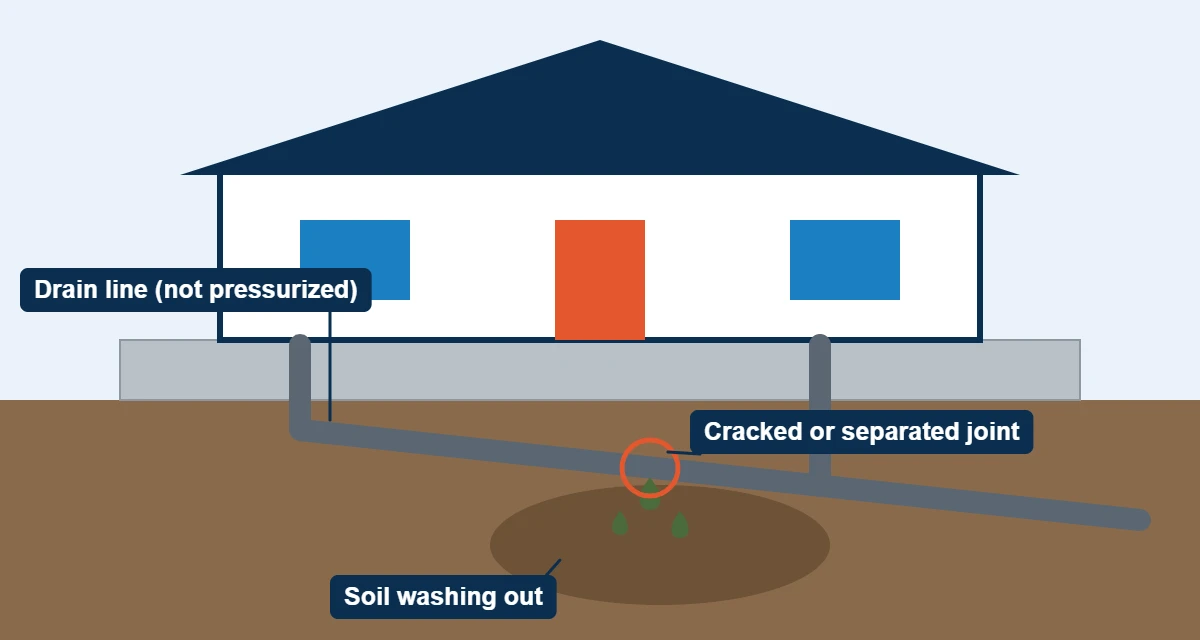
How Do Sewer Leaks Differ From Water Line Leaks?
It helps to understand the two systems separately, because everything about the diagnosis changes:
| Supply (water) lines | Sewer (drain) lines | |
|---|---|---|
| Pressure | Pressurized, 40-80 psi | No pressure — gravity flow only |
| Leak behavior | Continuous flow while pressurized | Intermittent — only when fixtures drain |
| First signs | High bill, hissing sound, warm spots | Odors, slow drains, damp areas |
| Main test | Acoustic listening | Hydrostatic testing |
| Pinpointing tool | Thermal imaging, tracer gas | Video camera inspection |
If your main symptom is a high water bill or running-water sounds, you likely need water line leak detection instead. Sewer issues announce themselves through smell and drainage behavior. When both systems are suspect, a thorough technician tests both — ask for that explicitly.

What Are the Signs of a Sewer Leak Under Your Slab?
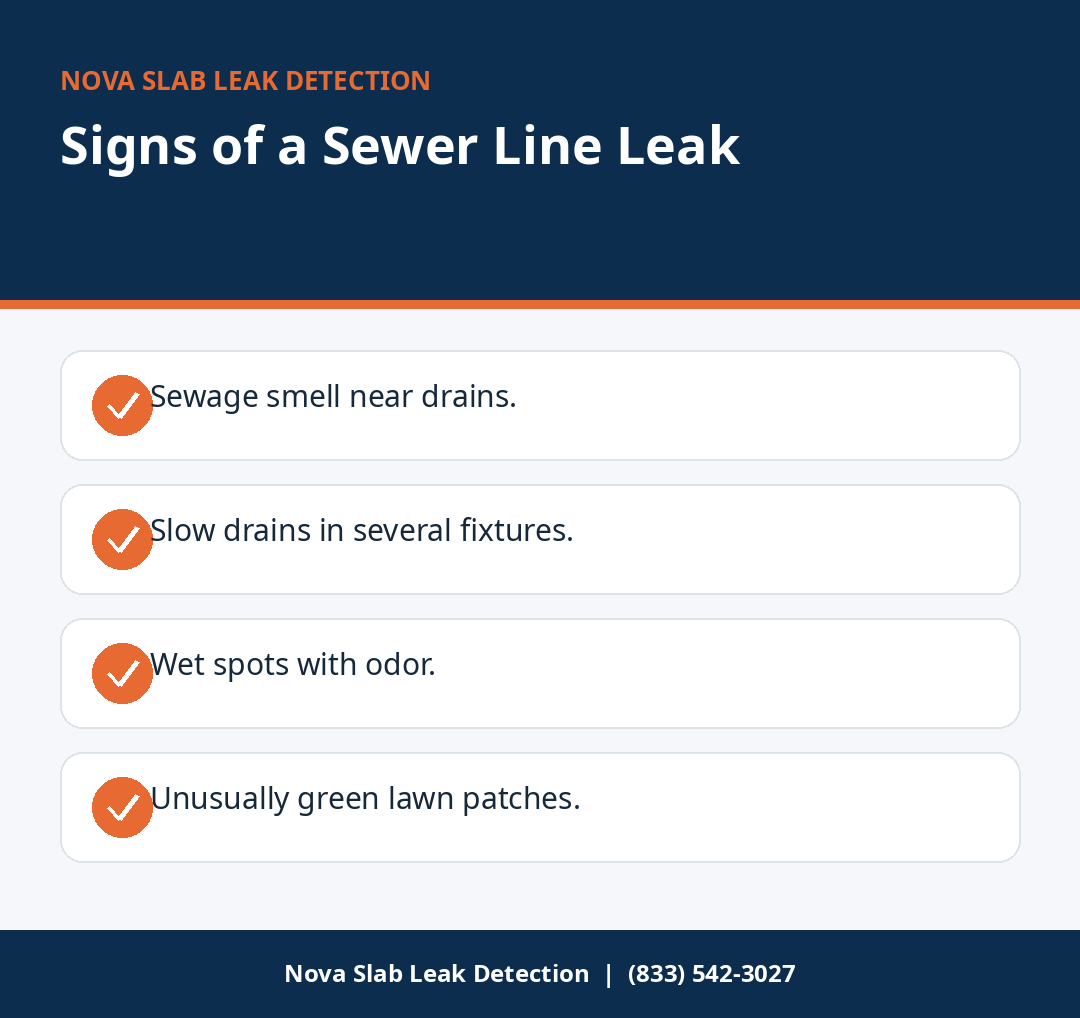
Sewer leaks are quieter than supply leaks, so watch for this pattern:
- Persistent sewage or musty odors indoors, especially near bathrooms or along baseboards, that cleaning does not fix.
- Multiple slow drains at once. One slow sink is a local clog. Sinks, tubs, and toilets all draining slowly together suggests a problem in the main line under the slab.
- Gurgling sounds from drains or toilets when other fixtures run — air is being forced through a compromised section.
- Damp or unusually lush patches of soil or grass near the foundation, or damp spots on slab-edge flooring.
- Foundation movement or new cracks with no other explanation. Escaping wastewater erodes the soil supporting the slab.
- An increase in pests. Sewer moisture attracts insects and can draw rodents toward compromised lines.
Any one of these can have another cause. Two or more, persisting for weeks, warrant a hydrostatic test. And one urgent note: if you see actual sewage backing up into tubs or floor drains, that is an active blockage or break — call for help the same day rather than scheduling a routine test.
What Is Hydrostatic Testing in Sewer Line Leak Detection?
Hydrostatic testing is the standard way to prove whether a drain system under a slab is leaking. Here is what actually happens during the test:
- The technician locates your main drain cleanout — usually a capped pipe near the home’s perimeter.
- An inflatable test ball (plug) is inserted into the main line and inflated, sealing the system.
- The drain lines inside the home are filled with water up to a marked level, often at a toilet flange or cleanout.
- The water level is watched for 15 to 30 minutes. If it holds, the under-slab drains are sound. If it drops, water is escaping somewhere below the slab.
A passing test is genuinely good news — it rules out the under-slab drains in one visit. A failing test confirms a leak exists, but not exactly where. That is when the camera comes out. Testing usually takes 1 to 2 hours, and most our technicians quote it as a flat per-visit service.
How Does a Video Camera Inspection Find Sewer Leaks?
Once a hydrostatic test fails — or when symptoms strongly suggest a drain problem — a waterproof camera on a flexible cable is fed through the drain lines. The live video shows exactly what is wrong and where:
- Cracks or breaks in the pipe wall, often with soil visible through the gap
- Separated joints where pipe sections have pulled apart as soil shifted
- Bellies — low spots where the pipe sags and wastewater pools instead of flowing
- Root intrusion where tree roots have entered through joints and grown into a mass
- Scale and buildup that narrow older cast-iron or clay lines
The camera head includes a locator beacon, so the technician can trace its position from above the slab and mark the problem spot on the floor — usually within a foot or two. This turns a vague “somewhere under the house” into a precise repair target, which is the difference between opening one small section of slab and tearing up half a room.
Why Do Sewer Leaks Threaten Your Foundation?
A supply-line leak wastes water and money. A sewer leak does that plus attacks the ground your home sits on:
- Soil erosion. Escaping wastewater washes fine soil particles away from beneath the slab, leaving voids. Slabs bridge small voids for a while, then crack or settle into them.
- Uneven support. Erosion rarely happens evenly, so one section of foundation loses support while the rest holds — the classic recipe for differential settlement and wall cracks.
- Contamination. Unlike clean supply water, wastewater introduces bacteria and organic matter into the soil under your home, which is a health concern as well as a structural one.
- Compounding damage. A settling slab stresses both supply and drain lines further, so one unrepaired sewer leak can trigger additional breaks over time.
This is why foundation specialists take sewer leaks seriously even when the homeowner’s main complaint is just an odor. If you have already noticed new cracks in walls or flooring alongside drain symptoms, mention both when you call — our team will prioritize accordingly.

What Happens After Sewer Line Leak Detection?
A confirmed sewer leak under a slab leaves a few paths, and our team should walk you through each:
- Spot repair through the slab. For a single break in an otherwise sound line, the slab is opened at the camera-marked location and the damaged section is replaced. National estimates as of 2026 for under-slab sewer spot repairs generally fall in the same $1,500-$4,500 range as supply-line spot repairs, though depth and access change the number.
- Rerouting the drain line. Sometimes the new line is run around or above the slab rather than beneath it, similar to supply-line rerouting.
- Pipe lining or bursting. For longer damaged runs, some companies offer trenchless rehabilitation — lining the old pipe or bursting it apart while pulling new pipe through. Suitability depends on the pipe’s condition and local codes.
- Full or partial replacement. For collapsed Orangeburg, clay, or cast-iron systems at the end of their life, replacement is the honest recommendation.
Whatever the recommendation, ask the same questions you would for any major plumbing work: what exactly was found on camera (ask to see the video), why this method and not the alternatives, what the warranty covers, and whether the quote includes concrete and flooring restoration. Details on repair approaches are on our slab leak repair page.
What Can You Check Yourself Before Sewer Line Leak Detection?
Before scheduling a test, gather evidence:
- The multi-fixture test. Run the washing machine and watch the nearest toilet and tub. Gurgling or water rising in fixtures you are not using points to the main line.
- The cleanout check. Find your main drain cleanout (often a white or black capped pipe near an exterior wall). Carefully remove the cap — standing water or sewage visible inside means a downstream blockage or break.
- The odor log. Note where and when smells are strongest, and whether they worsen after heavy water use like laundry day. Patterns help the technician.
- The foundation scan. Walk the perimeter and note any new cracks, sticking doors, or soil that stays damp days after rain.
Call Nova at (833) 542-3027 when odors persist for more than a week, when multiple drains are slow together, or when you see sewage anywhere it should not be. The line is open 24 hours a day, 7 days a week and the call is free. Our technicians do the work, explain what they find, and give you the price up front. One practical tip from the EPA: dry any water-damaged areas within 24 to 48 hours to prevent mold, and that applies to moisture from drain leaks too.
Sewer Line Leak Detection: Frequently Asked Questions
Services Related to Sewer Line Leak Detection
These pages cover what comes before and after sewer line leak detection.
- Slab Leak Repair: Four proven ways to fix a leak under your slab — and how to pick the right one.
- Water Line Leak Detection: How supply-line leaks are found and fixed without tearing up your whole home.
- Whole Home Repiping: When patching old pipes stops making sense, a full repipe ends the cycle.
- Slab Leak Detection: How non-invasive detection finds a leak under concrete, with methods, cost and accuracy.
- All Slab Leak Services: Every detection and repair service, compared in one place.
Need Sewer Line Leak Detection? Call Nova Today
Call any time, day or night. Tell us your ZIP code and what you are noticing, and we will book your visit for sewer line leak detection.
We also trace sewer line leaks across Southern California. Two of our most-visited city pages are slab leak detection in San Dimas and slab leak detection in Perris, where soil movement drives most calls.