
Video Pipe Inspection: A Camera View Inside Your Pipes
A waterproof camera travels inside your drain lines, showing exactly where cracks, breaks or roots are hiding.
Video Pipe Inspection: Quick Answers
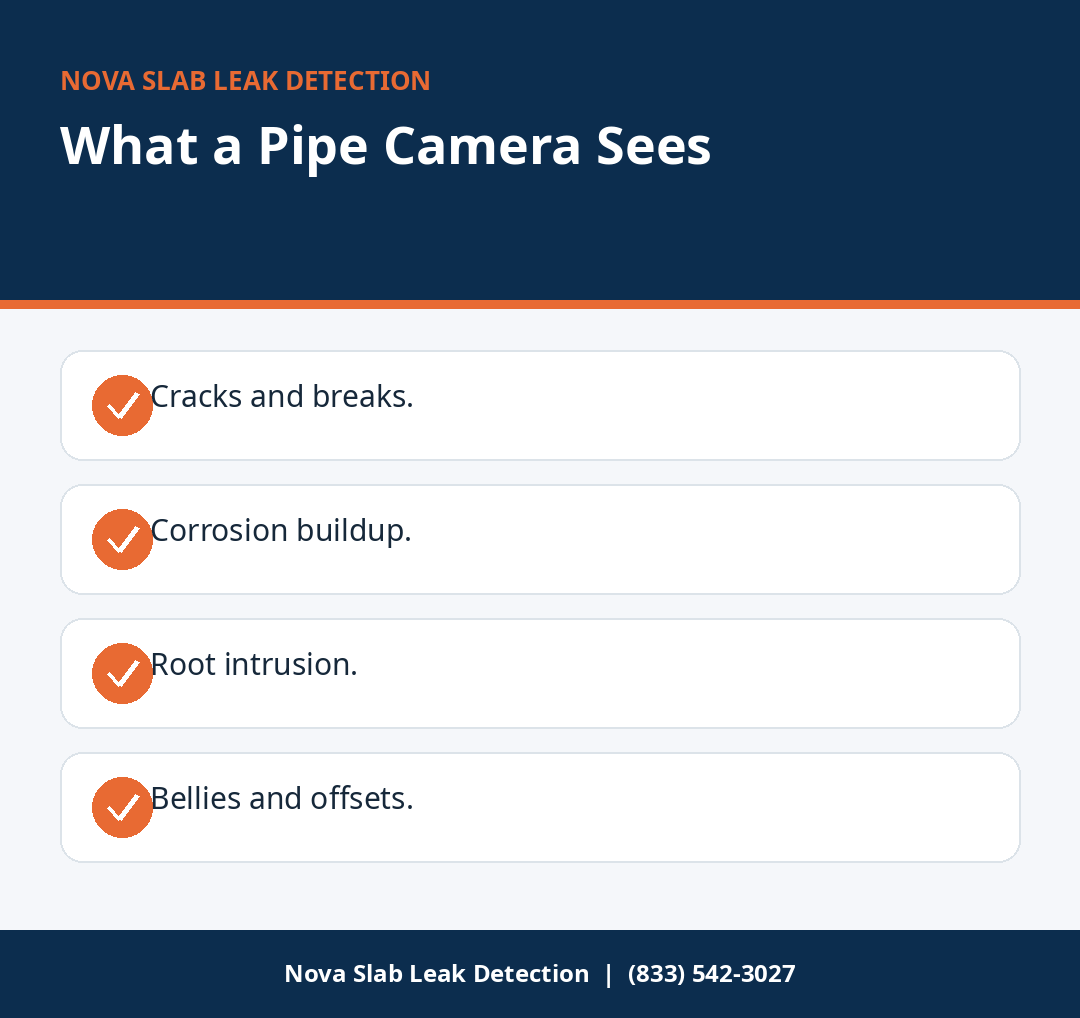
- How Does Video Pipe Inspection Work? A small waterproof camera is pushed through your drain pipes on a flexible rod, sending live video to a monitor.
- What Are the Limits of Video Pipe Inspection? A camera is powerful, but it has boundaries worth knowing before you book.
- When Should You Call for a Video Pipe Inspection? Call Nova at (833) 542-3027 if several drains are slow at once, you smell sewage with no visible source, or backups keep returning after snaking.
- How Much Does a Video Pipe Inspection Cost? A video camera inspection is usually part of a standard detection visit, which runs $150-$500 nationally, up to about $600 for complex homes — national estimates as of 2026.
How Does Video Pipe Inspection Work?
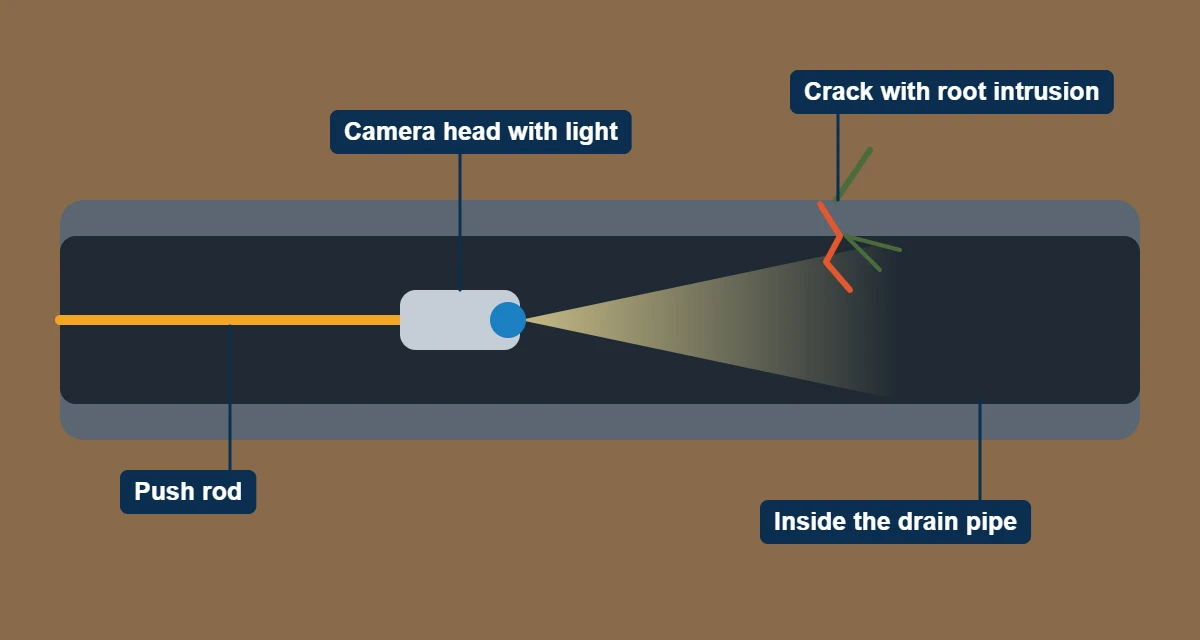
A small waterproof camera is pushed through your drain pipes on a flexible rod, sending live video to a monitor. Video pipe inspection works because the camera travels inside the pipe itself, so the technician sees cracks, breaks, roots, and sags directly instead of guessing from surface clues. A counter shows exactly how far in each problem sits.
The technician usually enters through an existing access point, such as a floor cleanout or a removed toilet. As the camera advances, you watch the same live feed on the monitor — the inside of your pipes, in real time. The whole process is non-destructive: no digging, no concrete work, and no mess beyond the access point. It is a core tool in modern slab leak detection, especially for the drain side of your plumbing.
What Can a Video Pipe Inspection Reveal Inside Your Pipes?
The footage tells a clear story. Here are the most common findings and what each one means.
| Finding | What it looks like | What it usually means |
|---|---|---|
| Crack | A visible split in the pipe wall | Leak point; needs repair or lining |
| Break or collapse | Crushed or missing pipe section | Serious failure; excavation or reroute likely |
| Root intrusion | White root masses entering through joints | Roots exploiting a crack; pipe is compromised |
| Belly (sag) | Low spot holding standing water | Poor bedding or soil settlement; chronic clog source |
| Offset joint | Pipe sections no longer aligned | Ground movement; leak and blockage risk |
| Heavy scale | Rough crust narrowing the pipe | Years of mineral buildup; reduced flow |
Any of the first four can be the source of a slab leak on the drain side. The footage removes all doubt about which one you are dealing with.
Why Is Video Pipe Inspection the Go-To for Sewer-Side Slab Leaks?
Supply lines and drain lines fail in different ways, and that changes the toolkit. Supply lines are pressurized, so escaping water makes noise and heat that acoustic leak detection and thermal imaging leak detection can pick up. Drain lines are not pressurized — wastewater simply flows downhill — so there is no hiss and no heat signature to find.
That is why the camera is the primary tool for sewer-side problems. It is often paired with hydrostatic testing, which first proves a drain leak exists by watching the water level drop. The test says “there is a leak”; the camera says “here it is, and this is what it looks like.” Together they give a complete diagnosis before anyone discusses opening concrete.
What Does Your Footage Report Look Like?
You do not just get a verbal summary — you get the evidence. A proper inspection report includes the recorded video file (or a link to it), still images captured at each problem spot, and a written summary noting each finding by distance, for example “crack with root intrusion at 47 feet from the cleanout.”
The report should also include the technician’s recommendations in plain language: what needs fixing now, what can wait, and which repair methods fit the situation. Keep this report. It is useful for getting comparable quotes, documenting the problem for a home sale, and supporting an insurance claim. Ask for a digital copy before the technician leaves.
What Are the Limits of Video Pipe Inspection?
A camera is powerful, but it has boundaries worth knowing before you book.
- Supply lines: the camera travels through drain pipes. Pressurized hot and cold supply lines are tested with pressure methods instead.
- Access required: the camera needs an entry point. If your home has no cleanout, the technician may need to pull a toilet, which adds time.
- Outside the pipe: the camera shows the pipe’s interior, not the soil or concrete around it. It cannot show how far water has spread — moisture mapping covers that.
- Murky water: heavy flow or sludge can cloud the picture until the line is cleared.
A straightforward pro will tell you when a camera is the wrong tool and suggest the right one instead.
What Can You Check Yourself Before a Video Pipe Inspection?
Drain-side problems usually announce themselves before a camera is ever needed. Watch for these.
- Multiple slow drains at once — one slow sink is a clog; several slow fixtures point to the main line.
- Gurgling sounds from toilets or tubs when other fixtures drain.
- Sewage odors coming from drains or near the slab.
- Water backing up in a shower when the toilet flushes.
- A history of repeat clogs in the same line, which often means a break, belly, or roots rather than a simple blockage.
Write down which fixtures are affected and when it started. That pattern helps the technician choose the right entry point and camera length.
When Should You Call for a Video Pipe Inspection?
Call Nova at (833) 542-3027 if several drains are slow at once, you smell sewage with no visible source, or backups keep returning after snaking. The phone line is open 24 hours a day, 7 days a week, and calling is free. Nova’s own technicians carry out the work and give you the price before it starts. If the camera finds moisture damage, remember the EPA guidance: dry water-damaged areas within 24 to 48 hours to prevent mold — see the EPA’s guide.
How Much Does a Video Pipe Inspection Cost?
A video camera inspection is usually part of a standard detection visit, which runs $150-$500 nationally, up to about $600 for complex homes — national estimates as of 2026. Some companies price a standalone camera inspection separately, so ask what is included when you book. If the footage reveals a break, your repair paths are compared on the slab leak repair page.
Video Pipe Inspection: Frequently Asked Questions
Services Related to Video Pipe Inspection
- Acoustic Leak Detection: Sensitive microphones hear what your ears cannot — pressurized water escaping under your slab.
- Hydrostatic Testing: Simple water and pressure tests prove whether a leak exists — before anyone touches your concrete.
- Moisture Mapping: See exactly where the water went — before you pay to open the slab.
- Slab Leak Detection: How non-invasive detection finds a leak under concrete, with methods, cost and accuracy.
- Slab Leak Repair: Four proven ways to fix a leak under your slab — and how to pick the right one.
Need a Video Pipe Inspection? Call Nova Today
Call any time, day or night. Tell us your ZIP code and what you are noticing, and we will book your visit.