
Slab Leak New Construction: Why New Homes Aren’t Immune
New homes can leak too. Here’s why it happens and how we fix it fast.
Slab Leak New Construction: Quick Answers
The short version of this guide to slab leak new construction:
- Why Can a Brand-New Home Get a Slab Leak? Yes, new homes can get slab leaks. A slab leak new construction problem often starts with rushed work.
- When Do New-Build Slab Leaks Show Up? Many show up in the first one to three years. Some appear in the first few months.
- Where Do Leaks Start in New Construction? They start where the work was hardest. Pipe bends and joints fail first.
Keep reading for the full guide to slab leak new construction, or jump to the common questions on slab leak new construction at the end.
Why Can a Brand-New Home Get a Slab Leak?
Yes, new homes can get slab leaks. A slab leak new construction problem often starts with rushed work. Bad soil prep or nicked pipes are common causes. New does not mean perfect. Concrete hides mistakes well. A small flaw can turn into a leak in months.
Do new homes really get slab leaks? Yes. We find them in homes less than a year old. New pipes can fail fast.
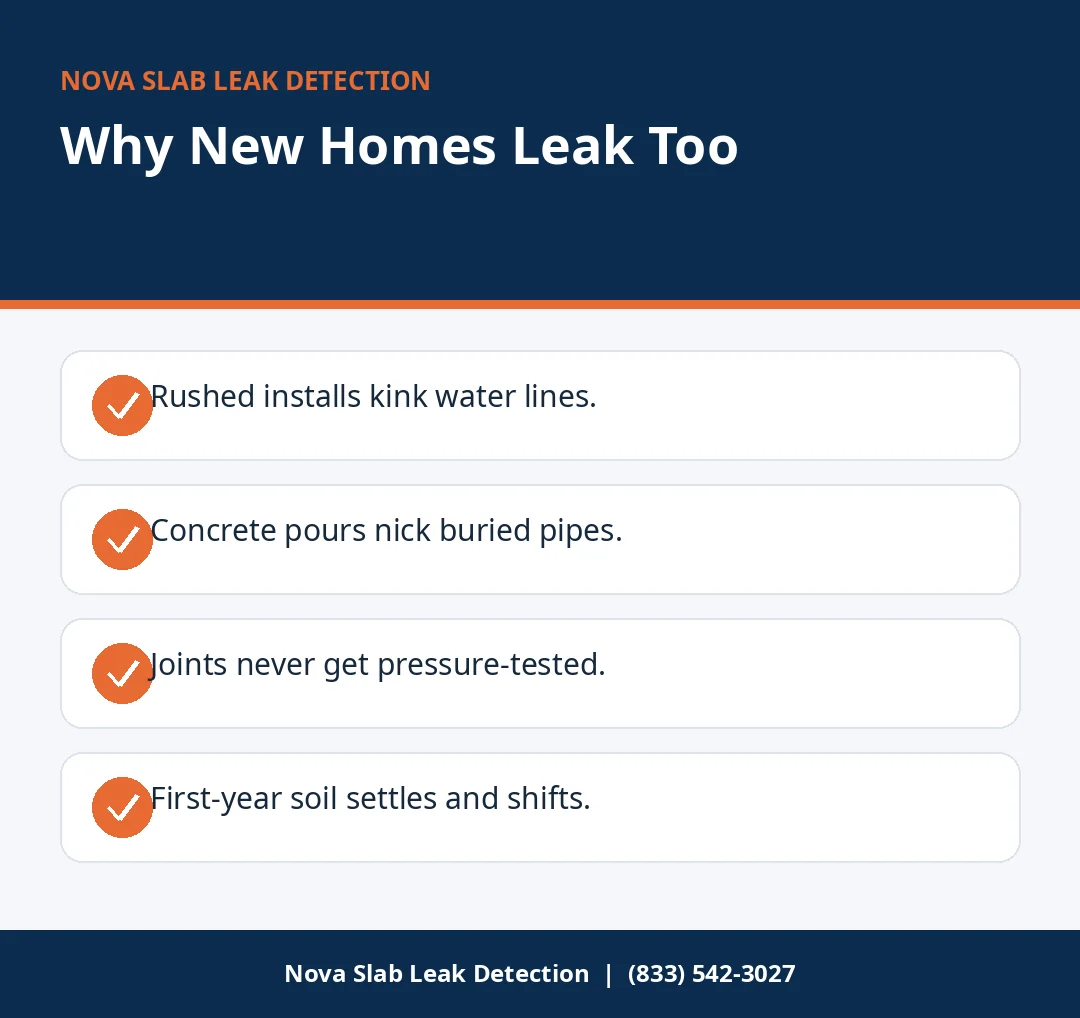
Most buyers assume new means safe. That trust is normal. But slabs cover the pipes. No one sees the work after the pour. A pipe can rub on rebar. A joint can be glued badly. Soil can shift as it settles. Any of these can open a leak.
When Do New-Build Slab Leaks Show Up?
Many show up in the first one to three years. Some appear in the first few months. The first full summer or winter can stress new pipes. Ground shifts. Concrete cures and shrinks. Weak joints give way.
Is the builder always at fault? Not always. Soil movement and water chemistry can hurt good work too. But install flaws are common.
Watch your first year closely. Check the water bill each month. Walk barefoot and feel for warm spots. Look at baseboards for stains. Early leaks are small. They grow fast.
Where Do Leaks Start in New Construction?
They start where the work was hardest. Pipe bends and joints fail first. Lines that cross rebar can wear through. Spots where pipes enter the slab are weak points. Kitchens and baths have the most joints. Those rooms leak most.
Slab edges can crack as soil settles. Water then finds the pipe. Hot water lines fail first in many new homes. Heat makes pipes expand and rub. That friction wears holes over time.
What Causes Pipes to Fail So Early?
| Cause | Why it happens in new builds |
|---|---|
| Bad joints | Glue or solder done too fast |
| Nicked pipes | Tools scrape pipes during the build |
| Rubbing on rebar | Pipes not kept clear of steel |
| Shifting soil | Fill dirt not packed down well |
| High water pressure | Pressure not set right at move-in |
| Chemical water | Hard or acidic water eats pipe walls |
Rushed schedules cause most of these. The slab then locks every flaw out of sight.
How Can You Spot a Leak in a New Home?
Look for the same signs as in old homes. A high water bill is the top clue. Warm spots on the floor mean a hot line leak. Damp carpet or warped wood points to water below. You may hear water when taps are off.
Can a home inspection catch it? At times. But most leaks start after the check. Keep watching after move-in.
Try the meter test. Turn off all water. Watch the meter for 15 minutes. If it moves, water is going somewhere. Our page on the water meter test walks you through it.
Who Fixes a Slab Leak in a New Build?
We do. Our technicians find and fix slab leaks every day. You call one number: (833) 542-3027. We are open 24/7. One call puts our team on it. We bring the listening gear and cameras. We pin down the leak spot. Then we fix it right.
What Does Slab Leak New Construction Repair Cost in 2026?
Costs run the same as in older homes. The job size sets the price, not the home’s age. Here are national estimates as of 2026:
| Job | National estimate as of 2026 |
|---|---|
| Detection visit | $150–$500 (up to ~$600 for complex homes) |
| Spot repair | $1,500–$4,500 |
| Reroute | $3,500–$7,000 |
| Tunneling | $3,500–$8,000 |
A builder warranty may pay for some of this.
How Does Our Detection Visit Work?
We keep it simple. Here is what happens:
- We ask about your signs and your home’s age.
- We test water pressure and check the meter.
- We use listening tools to hear the leak under the slab.
- We may use a small camera to confirm the spot.
- We show you what we found and lay out fix options.
Most visits take one to three hours. We find most leaks within a few feet. Then you choose the fix that fits your home and budget. Learn more about slab leak detection.


Will a Builder Warranty Cover It?
Maybe. Many builders give a one-year workmanship warranty. Some give longer cover on major systems. Plumbing often falls in a gray zone. Read your papers. Look for “plumbing” and “foundation” terms.
Should I wait for the warranty to handle it? No. Water damage grows daily. File the claim and call us now. We can document the leak for your claim.
Call the builder in writing. Keep copies. Take photos of damage. Do not let them stall while water spreads. A leak left alone can ruin floors and breed mold. Speed matters more than paperwork.
How Can You Prevent Slab Leaks in a New Home?
You cannot stop every leak. But you can cut the risk. Keep water pressure near 60 psi. High pressure strains joints. Get a softener if your water is hard. Hard water eats pipes from inside.
Watch the signs in year one. A leak caught early costs far less. Small damp spots are easy to miss. Do not ignore them. And know that some leaks hide for a long time — our guide on how long a slab leak can go unnoticed explains why.
One last tip: save our number now. (833) 542-3027. If a sign shows up at midnight, we answer. Explore all slab leak problems in our guide hub. Learn about our satisfaction guarantee too. If anything is not right, we make it right.
Slab Leak New Construction: Frequently Asked Questions
Homeowners often ask us these questions about slab leak new construction. Each answer is short, and the full detail on slab leak new construction is in the sections above.
Related Slab Leak Problems
More guides related to slab leak new construction:
- Slab Leak Radon Risk: A leak doesn’t make radon. But cracks can let it in. Here’s the calm truth.
- Slab Leak Renting Landlord: Renting with a slab leak? Here’s who usually pays and what to do first.
- Slab Leak Smell: Musty, earthy, or just off? Your nose may catch a slab leak before your eyes do.
- All slab leak problems: Every warning sign, cause and risk in one place.
- Slab Leak Detection: How we find a leak under concrete without breaking it.
The EPA estimates the average household’s leaks can waste more than 9,300 gallons of water a year (EPA WaterSense), which is why slab leak new construction is worth acting on early.
Slab Leak New Construction: Talk to Nova Today
Call any time, day or night. Tell us your ZIP code and what you are noticing, and we will book your visit. Mention slab leak new construction when you call so we bring the right equipment.