
Moisture Mapping: Tracking Hidden Water From a Slab Leak
See exactly where the water went — before you pay to open the slab.
Moisture Mapping: Quick Answers
- What Is Moisture Mapping? Moisture mapping is a room-by-room scan around a suspected slab leak that records how wet the floor and walls are at each point.
- How Long Does Moisture Mapping Take, and What Does It Cost? Moisture mapping is normally part of the detection visit, not a separate appointment — and a detection visit usually takes 1 to 3 hours.
- Why Does Moisture Mapping Matter Before Any Repair? Finding the leak is only half the job. Water from a slab leak can travel sideways under flooring and wick up into drywall far from the actual break.
What Is Moisture Mapping?
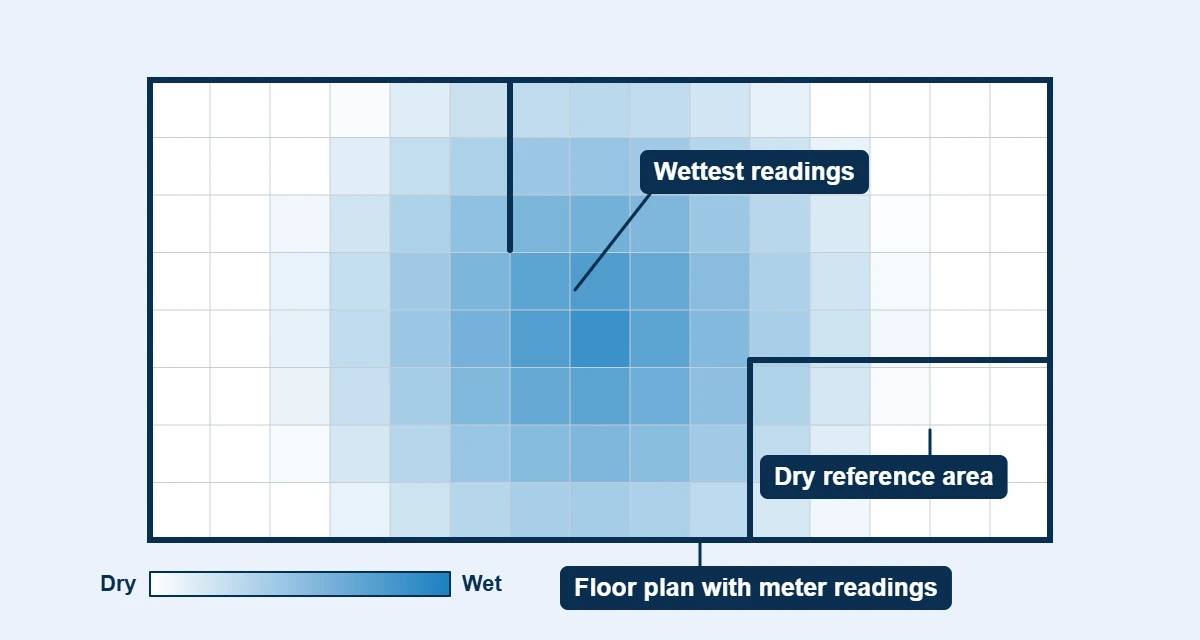
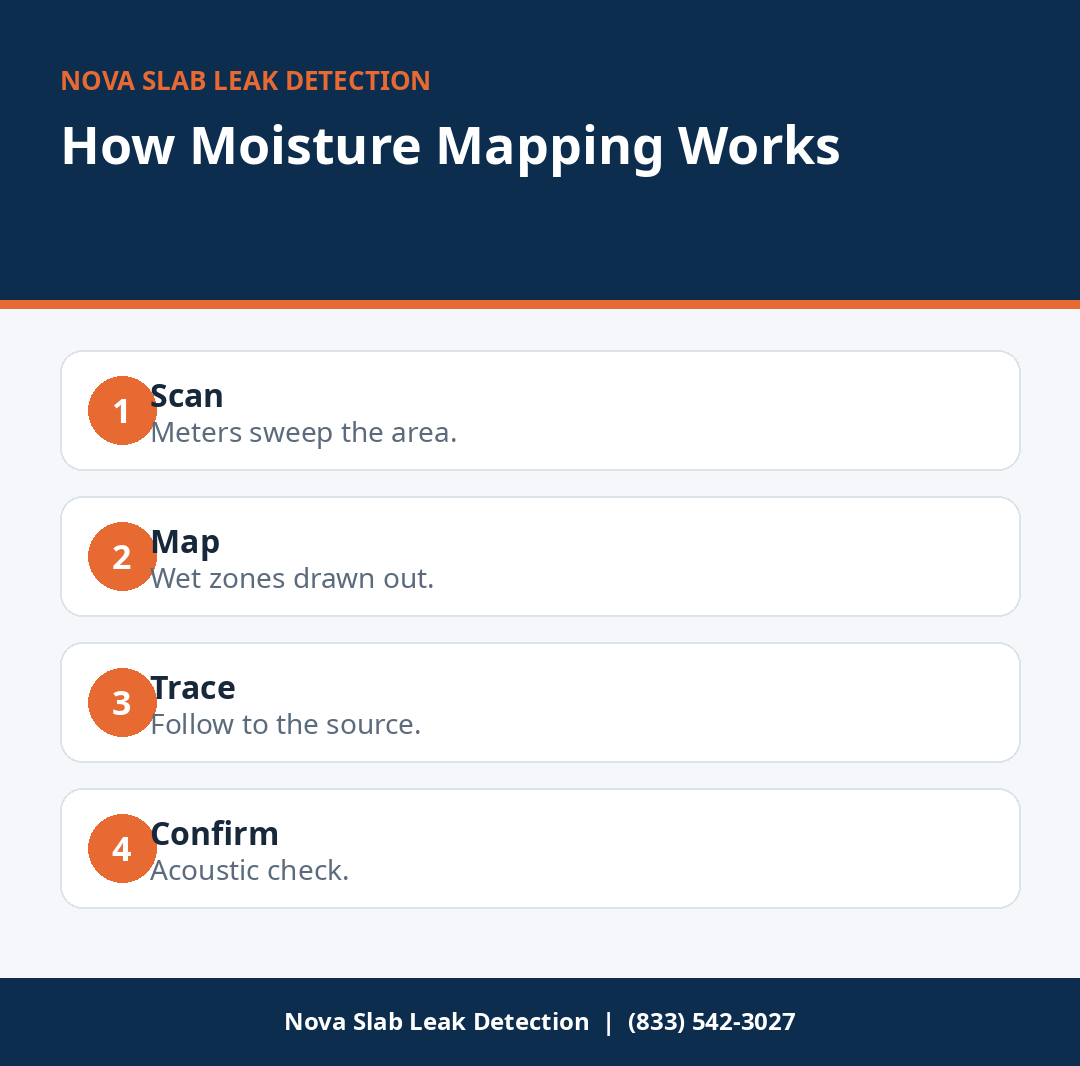
Moisture mapping is a room-by-room scan around a suspected slab leak that records how wet the floor and walls are at each point. A technician uses moisture meters and thermal hygrometers, then marks readings on a floor plan. The finished moisture mapping report reveals the true size of the problem — often far larger than the visible damp spot.
A hygrometer is simply a tool that measures moisture in the air or in building materials. Pin-type meters use two small probes; pinless meters scan without poking holes. Most moisture mapping happens during the same visit as leak detection — the two jobs answer different questions, and you usually need both answered before any repair begins.
Why Does Moisture Mapping Matter Before Any Repair?
Finding the leak is only half the job. Water from a slab leak can travel sideways under flooring and wick up into drywall far from the actual break. Without a map, a repair crew can fix the pipe while leaving soaked areas behind — and wet material left alone is where mold starts. The EPA advises drying water-damaged areas within 24 to 48 hours to prevent mold growth (epa.gov), which means you need to know exactly how much area is wet, and fast.
A moisture map also becomes documentation. If you file a homeowners insurance claim, a dated map with readings at each point shows the damage was real and measured — far stronger than “the floor felt damp.” Every policy is different, so check your policy for what it covers and what documentation it asks for.

Which Tools Are Used for Moisture Mapping?
- Pin-type moisture meters — two thin probes press into wood or drywall and measure electrical resistance, which changes with moisture content. Very precise, but they leave tiny pinholes.
- Pinless (non-invasive) meters — laid flat on the surface, they scan moisture to a set depth using electromagnetic signals. No damage, slightly less precise at depth.
- Thermal hygrometers — measure humidity in the air and at surfaces, helping the technician tell a genuine leak apart from ordinary household humidity.
- Thermal imaging cameras — show temperature differences across the floor; cold patches often mark wet areas hiding under tile or laminate.
A good technician uses at least two of these and cross-checks the readings — one tool alone can mislead, especially in humid weather.
Moisture Mapping vs. Leak Detection: What’s the Difference?
| Leak detection | Moisture mapping | |
|---|---|---|
| Question it answers | Where is water escaping from the pipe? | How far has the escaped water spread? |
| Main tools | Acoustic listening, thermal imaging, tracer gas | Moisture meters, hygrometers |
| Typical result | Leak location within about 1 to 3 feet | Floor-plan map of wet vs. dry zones |
| Visit length | Usually 1 to 3 hours for both together | Done in the same visit |
| Skip it and… | You don’t know where to repair | You don’t know how much to dry or replace |
What Does Your Moisture Map Report Show?
- A floor-plan sketch with a moisture reading marked at each test point.
- Wet and dry zones — usually color-coded so the spread is obvious at a glance.
- The highest-reading area, which is typically closest to the leak source.
- Dry baseline readings from an unaffected room, for comparison.
- Photos of visible damage: staining, buckling, or mold.
- A recommendation — what needs professional drying, what can air-dry, and what may need removal.
Keep a copy of the report. You’ll want it for the repair crew, and possibly for your insurer.
How Long Does Moisture Mapping Take, and What Does It Cost?
Moisture mapping is normally part of the detection visit, not a separate appointment — and a detection visit usually takes 1 to 3 hours. National estimates as of 2026 put professional leak detection at $150–$500, up to about $600 for complex homes.
One honest note: mapping alone cannot find your leak. It measures damage, not the source. If a company offers “moisture mapping” as a standalone leak-finding service, ask how they pinpoint the break itself before you agree to open the slab.
What Can You Check Yourself Before Moisture Mapping?
You can do a rough version tonight:
- Plastic-sheet test: tape a 2-foot square of clear plastic to the suspect floor area, seal all edges, and check in 24 hours. Moisture trapped underneath means water is coming up through the slab.
- Water meter test: turn off every faucet and appliance, then watch your water meter for 15 minutes. If it moves, water is escaping somewhere.
- Sniff and photograph: musty smells near baseboards, plus dated photos of any staining or buckling.
Call Nova at (833) 542-3027 if the meter moves with everything off, the damp area is growing, or you smell mold — the line is open 24 hours a day, 7 days a week, and calling is free. Nova will send a technician who can map the moisture and pinpoint the leak.
What Are the Limits of Moisture Mapping?
- Meters read moisture near the surface — they cannot see the pipe or the exact break point. That’s the detection equipment’s job.
- High indoor humidity, recent mopping, or a humid climate can skew readings, which is why pros cross-check with multiple tools.
- A map is a snapshot: if the leak is still active, the wet zone keeps growing until the source is fixed. Mapping guides the repair; it is not the repair.
Moisture Mapping: Frequently Asked Questions
Services Related to Moisture Mapping
- Thermal Imaging Leak Detection: Infrared cameras reveal hidden hot-water leaks beneath your slab — before any concrete is cut.
- Tracer Gas Leak Detection: A safe, non-flammable gas mix pinpoints tiny slab leaks that other methods miss.
- Video Pipe Inspection: A waterproof camera travels inside your drain lines, showing exactly where cracks, breaks or roots are hiding.
- Slab Leak Detection: How non-invasive detection finds a leak under concrete, with methods, cost and accuracy.
- Slab Leak Repair: Four proven ways to fix a leak under your slab — and how to pick the right one.
Need Moisture Mapping? Call Nova Today
Call any time, day or night. Tell us your ZIP code and what you are noticing, and we will book your visit.