
Pinhole Leaks Copper Pipes: Why They Happen & How We Fix Them
Tiny holes, big trouble. We’ll explain pinhole leaks in plain terms and fix them right.
Pinhole Leaks Copper Pipes: Quick Answers
The short version of this guide to pinhole leaks copper pipes:
- What Makes Pinhole Leaks Copper Pipes Develop Over Time? Pinhole leaks copper pipes from the inside out. Tiny pits eat the copper wall.
- What Is Pitting in Plain Terms? Copper is strong but not perfect. Water can wear it down. Tiny pits form deep in the wall.
- Why Does Water Type Matter? Some water is harsh to copper. Low pH is a big cause. High chlorine can hurt too.
Keep reading for the full guide to pinhole leaks copper pipes.
What Makes Pinhole Leaks Copper Pipes Develop Over Time?
Pinhole leaks copper pipes from the inside out. Tiny pits eat the copper wall. One pinhole often means more are on the way. Our team finds each weak spot. We fix the leak you see. We check the lines you can’t see too.
Think of rust on a car. It starts small and hidden. Then it breaks through. Copper pits the same way. The hole is tiny. The harm grows fast.
What Is Pitting in Plain Terms?
Copper is strong but not perfect. Water can wear it down. Tiny pits form deep in the wall. They grow year by year. One day one breaks through.
Is pitting the same as rust? Not quite. Rust hits iron and steel. Pitting hits copper. Both eat metal slow. Both start where you can’t see.
Why Do Some Homes Get Pits?
Water differs by town. Some water is hard on copper. Fast flow wears walls more. Heat adds stress too. Age does the rest.
Why Does Water Type Matter?
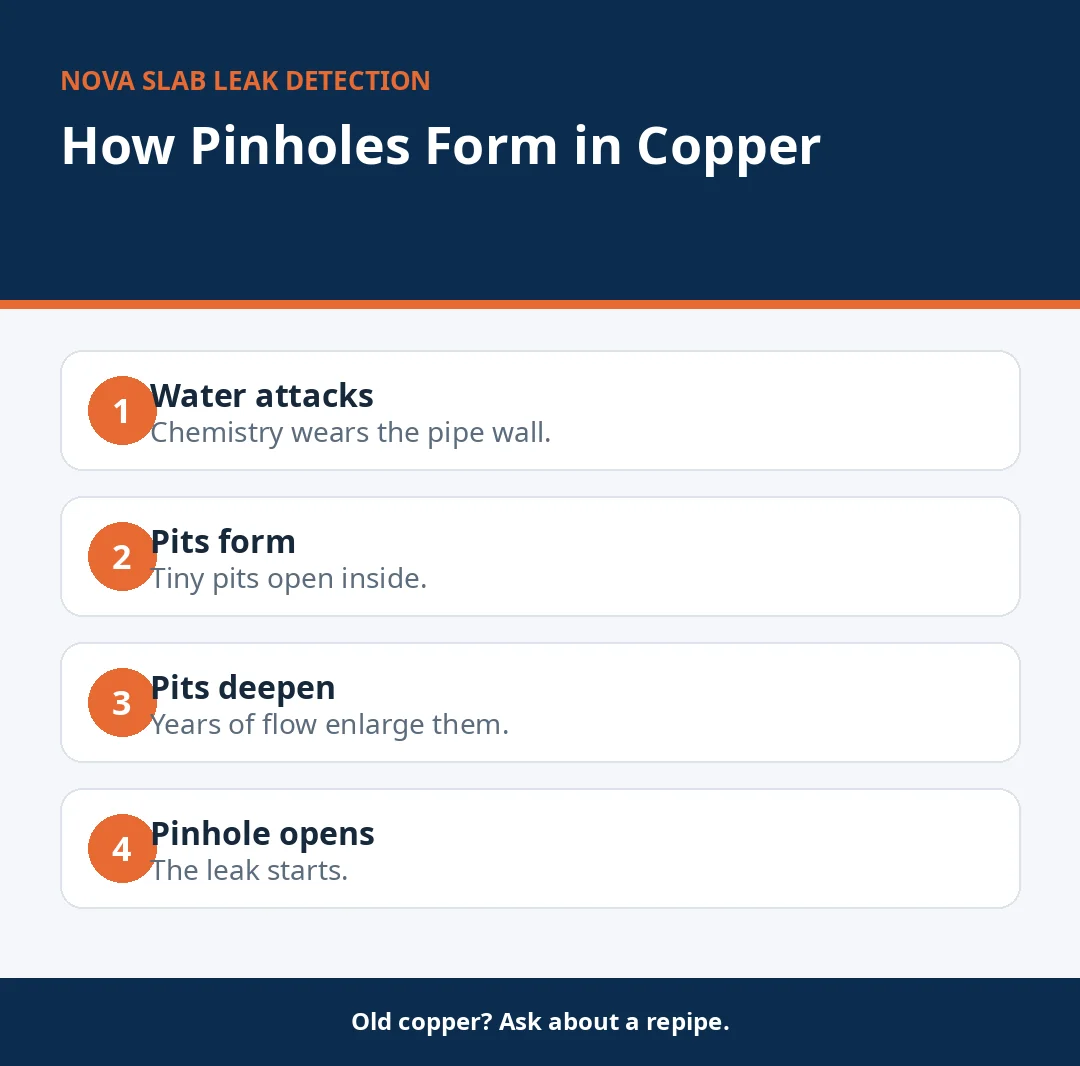
Some water is harsh to copper. Low pH is a big cause. High chlorine can hurt too. Bits in the water rough up pipe walls. Rough spots turn into pits.
You can’t see your water type. Your pipes feel it each day. If neighbors get pinholes, your risk is up. Same water and pipe age means same risk.
What Early Clues Point to Pinhole Leaks?
Green stains on bare pipe. White crust at joints. A damp smell near walls. Wet spots with no spill. A bill that creeps up.
What does a pinhole look like? Just a green dot at first. At times a fine mist sprays. You may hear a faint hiss in a wall. Small now is cheap to fix.
| Sign you see | What it may mean |
|---|---|
| Green dot on pipe | Early pitting |
| White crust at joint | Slow seep |
| Faint hiss in wall | Live pinhole |
| Damp spot, no spill | Leak back of wall |
| Bill creeping up | Hid flow somewhere |
When Do Pinholes Turn Serious?
One pinhole is a warning. Three or four is a trend. A trend means the pipes are old. Wait, and a small fix turns big. Harm grows each week.
Slab lines are the worst place. You can’t see them. You can’t hear them well. Try the water meter test. It can show hid flow.
Where Do They Hit Most?
Hot lines fail first. Heat speeds up harm. Bends and joints are weak. Fast turns wear more. Long straight runs last best.
Under-slab copper is high risk. Soil rubs the pipe. Old jobs lack guards. We see this a lot. Age plus soil is a bad mix.
Who Should Fix a Pinhole Leak?
We should. Our techs fix pinholes each day. We cut out the bad part. We join in clean new pipe. Then we test at full force. Call (833) 542-3027. We are here 24/7.
Can I clamp it myself? A clamp buys a bit of time. It won’t hold long. It hides the true harm too. Let us fix it right.
How Do We Fix Pinhole Leaks?
First we find each leak. Not just the loud one. Our gear hears hiss through walls. We open the least we must. We swap the bad part. We test hard before we close.
If pits are all over, we may urge a reroute. New lines skip the bad copper. Spot fixes run $1,500–$4,500. Reroutes run $3,500–$7,000. These are national estimates as of 2026. We urge just what you need.
Our work has our satisfaction guarantee. If it isn’t right, call us. We’ll make it right.
Can New Pinholes Be Stopped?
You can slow them down. You can’t stop them all. Soft water helps harsh types. Less heat stress helps too. But old copper will pit in time.
Should I swap all my copper now? Not out of fear. Get a check first. We will tell you the true state. Then you plan by facts. See our plumbing problem guides. Learn how slab leak detection works.
How Often Should You Check Aging Copper?
Once a year is a good pace. Look at bare pipes you can see. Check joints and bends first. Note any green or white crust. Snap a photo each time. Compare year to year. Changes mean action. If your copper is past 20 years, check twice a year. Old systems fail faster. A quick look costs nothing. Catching pits early saves thousands.
Ask us to inspect during any visit. We check visible lines with detection. One visit can map your whole system. Early maps guide smart plans.
Pinhole Leaks Copper Pipes: Frequently Asked Questions
Homeowners often ask us these questions about pinhole leaks copper pipes. Each answer is short, and the full detail on pinhole leaks copper pipes is in the sections above.
Related Slab Leak Problems
More guides related to pinhole leaks copper pipes:
- Slab Leak After Earthquake: The shaking stopped. Now check your pipes with this calm, simple checklist.
- Slab Leak and Mold Health: Leaks feed mold. Here’s what that may mean for health — and what to do.
- Slab Leak in Winter: Cold snaps are hard on pipes. Here’s why winter raises slab leak risk — and how to stay ahead.
- All slab leak problems: Every warning sign, cause and risk in one place.
- Slab Leak Detection: How we find a leak under concrete without breaking it.
The EPA estimates the average household’s leaks can waste more than 9,300 gallons of water a year (EPA WaterSense), which is why pinhole leaks copper pipes is worth acting on early.
Pinhole Leaks Copper Pipes: Talk to Nova Today
Call any time, day or night. Tell us your ZIP code and what you are noticing, and we will book your visit. Mention pinhole leaks copper pipes when you call so we bring the right equipment.