
What Makes Mississippi Soil Tough on Pipes?

Mississippi has two soils that spell trouble for pipes. The Delta sits on Yazoo clay, a highly expansive clay that heaves when wet. Mississippi homeowners count on our slab leak detection, done by Nova’s own technicians. The southern coast sits on sands that shift and let leak water roam.
Yazoo clay is highly expansive. Soak it and it swells with force. Bake it and it cracks wide open. Slabs ride up and down on this cycle. Pipes under the slab bend and strain. Joints give first, then pipe walls. Each summer bakes the clay hard. Each storm swells it back. The slab never rests. Coastal sands play a quieter trick. They do not grip the pipe. They let water from a leak travel far. You may find damage rooms away from the break. Sand also drains fast. A leak can run long with no puddle. Your bill may be the only clue. Read it each month.
See why soil movement breaks pipes and what it means for Delta homes.
Q: Does Yazoo clay really move that much? A: Yes. Its strong shrink-swell cycle lifts and drops slabs year after year. That motion cracks pipe joints over time. Delta homes deserve watchful eyes and quick testing.
How Do I Know My Slab Is Leaking?

Look for the classic clues. Early signs are easy to miss. Look twice. Bills climb with no cause. Floors feel warm in spots. Water runs in quiet pipes. Dampness creeps across carpet. Pressure fades. Cracks spread. Musty air lingers. Any two together mean it is time to test. Trust the pattern, not a single sign.
Snap a photo of each sign. Photos help our tech. Dates help too. Bring both to the visit.
Q: Can damage show up far from the actual leak? A: Yes, in sandy soil. Water roams through sand with ease. We trace it back to the source with sound and heat tests.
Should I Turn Off My Water Before You Come?
No. Leave it on. We need live pressure to test. A shut valve hides the leak from our gear. If water is gushing, shut it off and call us at once. Leave the valve as is. We will handle the rest.
What Happens When Our Technician Arrives?
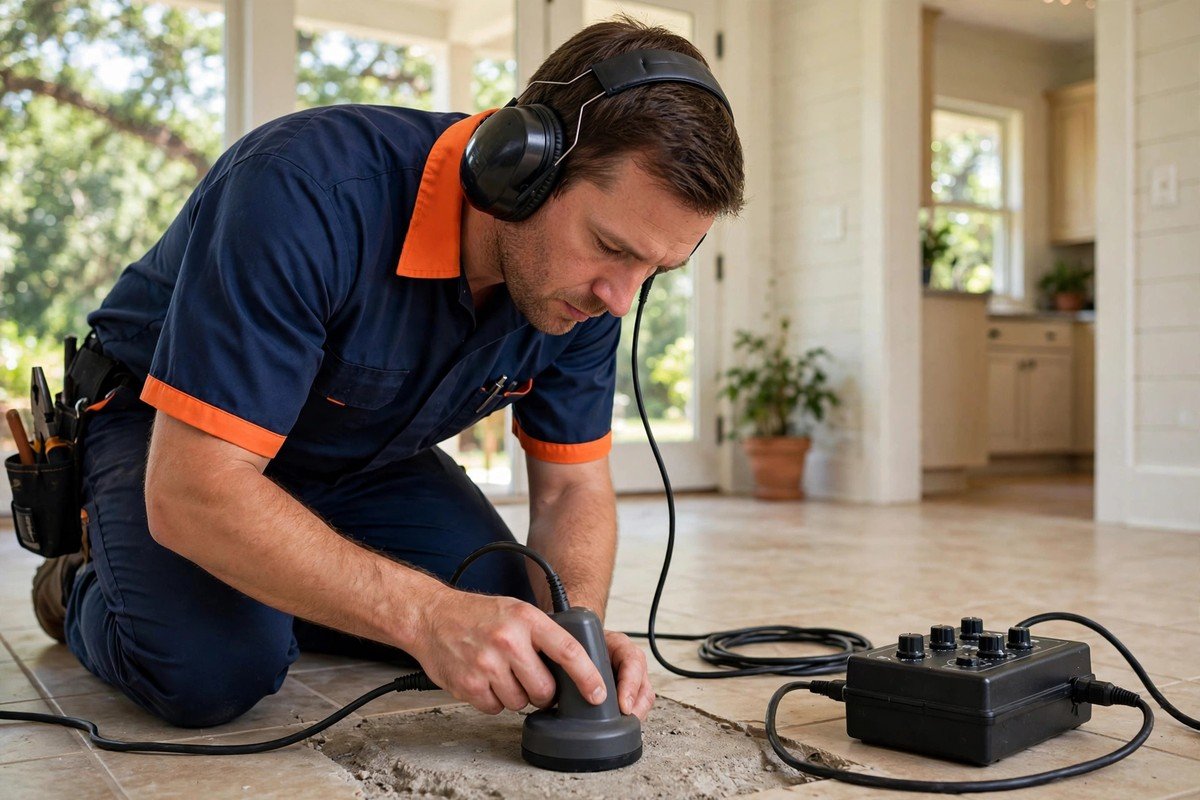
First we talk. Your technician hears your signs and your timeline. Then we meter-test for hidden flow. Then we listen with acoustic gear for the leak’s hiss. Then we scan with thermal imaging for hot trails. Then tracer gas if we need it. One to three hours in, we mark the leak to about one to three feet.
Concrete stays whole until the mark is set. See our process for the full visit walkthrough.
Will the Visit Get in My Way?
Barely. We work inside your home with handheld gear. No jackhammers during testing. Most folks go about their day while we work.
Where in Mississippi Can You Get Our Help?
We serve an expanding service area in Mississippi. Delta clay country and Gulf Coast sand country alike. See all areas we serve.
Our techs know both soils. They test Delta clay and coastal sand every week. The tools adapt. The skill stays the same.
Who Should Call Us Today?
Call with any two signs. Call with a meter that will not sit still. Call with cracks that grow by the month. Each week of waiting lets water do more harm. Wet soil moves more under your slab. Moving soil strains more pipe. Stop the loop early.
A stain that grows is a clock ticking. A bill that climbs is money lost. Both point one way. Call before the next round of bills. The EPA mold guide calls for drying wet materials within 24 to 48 hours.
Q: Does insurance pay for slab leaks? A: Policies vary. Damage from sudden leaks is often covered. The worn pipe itself often is not. Your agent can confirm. Our insurance FAQ lists good questions to ask.
How Do Detection Methods Compare?

We use three tools. Each shines in a different spot:
| Method | What it finds | Best for |
|---|---|---|
| Acoustic listening | The hiss of escaping water | Pinpointing the leak’s location |
| Thermal imaging | Heat trails from hot lines | Hot water leaks under floors |
| Tracer gas | Gas rising at the break | Leaks that hide from sound and heat |
Your technician picks the right mix for your home. As for price, here are national estimates as of 2026. Detection visits run $150 to $500. Complex homes reach about $600. Spot fixes range from $1,500 to $4,500. A whole-home repipe ranges from $4,500 to $15,000. Full ranges live in our cost guide.
Your tech will price your exact job on site. You will see it in writing. You choose before we start.
Q: Which method will you use at my home? A: Whichever the signs call for. Most visits use sound and heat. Stubborn leaks get tracer gas too. You pay for answers, not for a fixed tool list.
FAQs
How fast is detection in Mississippi?
One to three hours in most homes. We mark the leak location the same day we visit.
Can sand hide where the leak is?
Yes. Water roams in sand. Our tools trace it back to the true source.
Do you fix leaks as well as find them?
Yes. Our technicians detect and repair. One team, start to finish.
Is Yazoo clay damage covered by insurance?
Policies vary. Sudden water damage is often covered. Gradual pipe wear often is not. Ask your agent.
How do I book a visit?
Call (833) 542-3027. We take calls 24 hours a day, 7 days a week.
What if I am unhappy with the work?
Call (833) 542-3027. If our work disappoints you, we will return and make it right. Clay moves and sand shifts, but we stand by our work, 24/7 by phone.