
How Do Soils Here Break Buried Pipes?
Slab leak detection Massachusetts has two soil stories. Most of the state sits on glacial till, a rocky mix left by ice. Around Boston, the ground holds blue clay. Both soils shift with water and frost. Buried copper cannot bend forever. That shift is why so many slabs leak here.
What Is Boston Blue Clay?
Blue clay sits under much of greater Boston. It is soft. It squashes under weight. It swells when wet and shrinks as it dries.
That shrink-swell never rests. A slab on blue clay rises and falls a bit each year. Water lines under the slab bend with it. Joints wear out. Pinholes open in thin spots.
How Does Glacial Till Stress Lines?
Outside the Boston basin, till rules. It is a dense mix of stones, sand, silt, and clay. It drains slowly. Water pools in it around the slab.
Winter makes it worse. Till freezes into a hard mass. Frost heave lifts the slab in lopsided sheets. Spring thaw drops it back. Each cycle bends pipe at the same weak joints.
Is blue clay only a Boston issue? Mostly, yes. The basin clay is a Boston-area thing. But till covers most of the rest of the state. Both soil types shift slabs and stress buried lines.
Why Is Freeze-Thaw the Final Straw?
Winters here freeze ground deep. Heave lifts soil by inches, not bits. Slabs crack under that force. Lines crack with them.
Older homes carry the most risk. Copper from the 1960s and 1970s has faced fifty winters. Metal gets tired. One hard freeze can finish a joint that was already worn.
What Warning Signs Should You Watch?
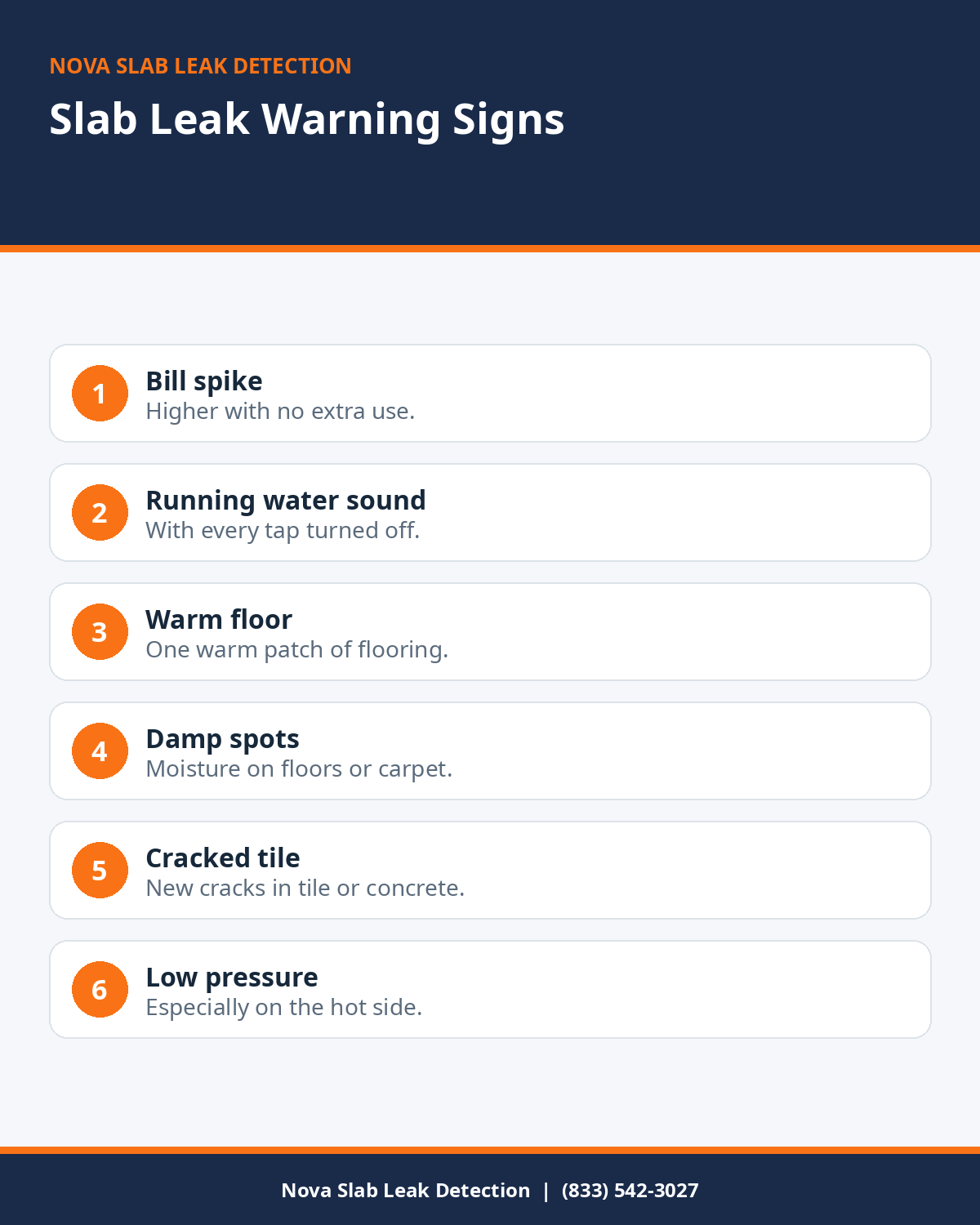


| Sign | What it may mean |
|---|---|
| Water bill jumps | Hidden leak losing water under the slab |
| Running water sounds | Live line leaking with taps off |
| Warm floor spots | Hot water line leak below |
| Damp or musty carpet | Cold line weeping into floors |
| Cracked tile lines | Slab shift from a leak below |
| Low water pressure | Line losing flow under the slab |
One sign alone may mean nothing. Two or more deserve a call. Early checks catch leaks before floors and walls get hurt.
My bill rose but I see no water. Is that normal? Yes. It is the most common first sign. Slab leaks hide under concrete. You pay for lost water long before you see it. A meter check tells the truth fast.
When Do Leaks Show Up Most Here?
Late winter into spring is peak season. February frost heaves hardest. March and April thaw drops the ground in a lopsided way. That lift-and-drop breaks worn joints.
January cold snaps run second. A deep freeze after rain is brutal. Water in the soil turns to ice and grows. The force has to go somewhere. Pipes feel it.
Summer storms bring a smaller wave. Heavy rain soaks clay and till. Swelling soil pushes the slab. But winter harm still causes most failures we find.
Where Does Nova Serve in Massachusetts?
We serve an expanding service area in Massachusetts. That is full statewide coverage, from the Berkshires to the Cape. Every slab home here is in our area.
Nova Slab Leak Detection reaches all 50 states plus DC. Ring (833) 542-3027 any time — we are open 24/7, and the phone is the only way to reach us. Browse all our areas on the locations page.
Who should make the call?
Call if your water bill spiked with no new use. Call if you hear water running when all is off. Call if floors feel warm, damp, or soft. Call if tiles crack in lines you cannot explain.
If your home has its first copper lines, call sooner. Decades of freeze-thaw wear metal thin. A quick check now beats a flooded room later.
Home buyers should call too. A slab leak check before closing can save thousands. Sellers rarely know of hidden leaks. We can rule one out fast.
Could my insurance help with costs? Maybe. Policies vary a lot. Many pay for harm the leak caused, not the pipe fix. Ask your carrier direct. Our insurance FAQ covers key terms.
How Does Our Technician Pinpoint the Leak?
Your technician starts by hearing your story. We ask what changed and when. We check the water meter. We look at your bill past. That frames the search.
Then we hear the slab. Sound tools pick up the noise of leaking water through concrete. Heat cameras map warm and cool zones. Tracer gas traces faint leaks we cannot hear.
The visit takes 1 to 3 hours. We narrow the leak to about 1 to 3 feet before any concrete gets touched. You get a clear report and real options. Most visits need no digging at all.
See every step on our process page.
Will detection tear up my home? No. Our tools do not cut or break a thing. We find the leak first, then talk options. Your floors stay whole through the visit.
What does slab leak work cost here?
The figures below are national estimates as of 2026. Your home and fix choice set the final sum.
A detection visit runs $150–$500, up to about $600 for complex homes. Spot repair through the slab runs $1,500–$4,500. Reroute around the slab runs $3,500–$7,000. Tunneling under the slab runs $3,500–$8,000. Epoxy lining runs $3,000–$6,000. Whole-home repipe runs $4,500–$15,000.
Our cost guide and detection cost FAQ lay it all out.
What pushes a fix to the high end? Poor access. Leaks under finished rooms cost more than leaks under garages. Two-story reroutes run higher. We show options at each price point after we find the leak.
FAQs
How fast can you get to my home?
Call (833) 542-3027 and we will book the first open slot. We answer 24 hours a day, all year.
Can a slab leak harm my slab?
Yes. Leaking water washes soil from under the slab. That leads to sink spots and cracks. Fast checks stop it early.
Should I fear mold?
Yes, if water sits. Per the EPA mold guide, wet spots should dry within 24 to 48 hours. Call at the first damp sign.
Do you fix the leak too?
Yes. We find and we fix. Our technicians do spot repairs, reroutes, tunneling, and lining.
What if you find nothing?
You get a clean report and peace of mind. We will point to what else may cause your signs. You pay only for the visit.
Is there a promise on the work?
Yes. If something is not right, call us and we will work to make it right. Each job carries that promise.
Do I need to leave home during repairs?
Almost never. Most fixes take a day or two. You can stay home for the check and most repairs.