
Slab Penetration and Concrete Restoration After a Leak Repair
A small, precise opening in the slab — then your concrete is restored like it was never touched.
Slab Penetration and Restoration: Quick Answers
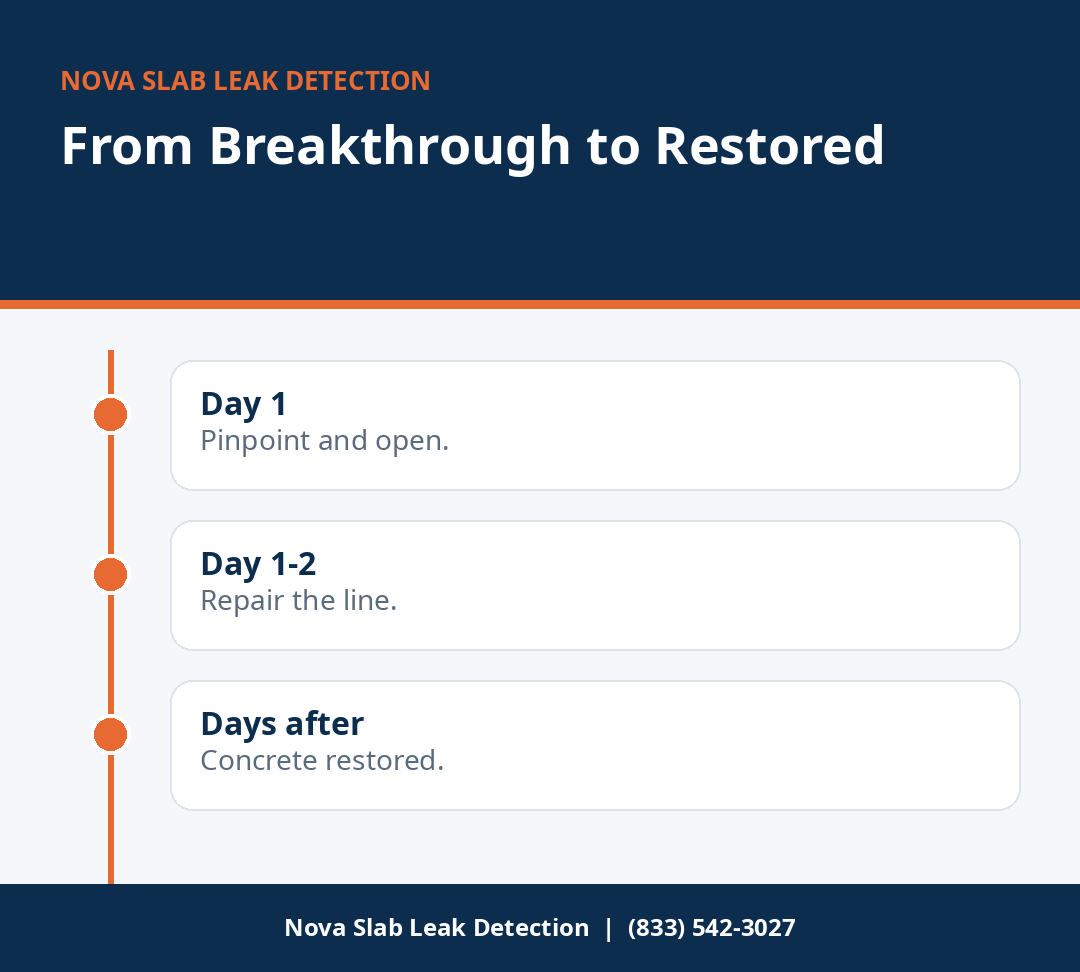
- What Does Slab Penetration (“Breaking Out” the Slab) Mean? “Breaking out” the slab means cutting a small, targeted section of your concrete foundation to reach the leaking pipe underneath — after detection pinpoints the leak within about 1 to 3 feet.
- How Long Does Slab Penetration and Restoration Take, and What Does It Cost? A straightforward spot repair through the slab often takes one day of work, plus 1 to 3 days of concrete curing before flooring goes back.
- How Does Pinpoint Detection Keep the Slab Penetration Small? Decades ago, finding a slab leak meant jackhammering a trench across the room and hoping for the best.
What Does Slab Penetration (“Breaking Out” the Slab) Mean?
“Breaking out” the slab means cutting a small, targeted section of your concrete foundation to reach the leaking pipe underneath — after detection pinpoints the leak within about 1 to 3 feet. Slab leak concrete restoration is everything that follows: the pipe is fixed, the hole is backfilled, and fresh concrete is poured so your foundation is solid again.
How Does Pinpoint Detection Keep the Slab Penetration Small?
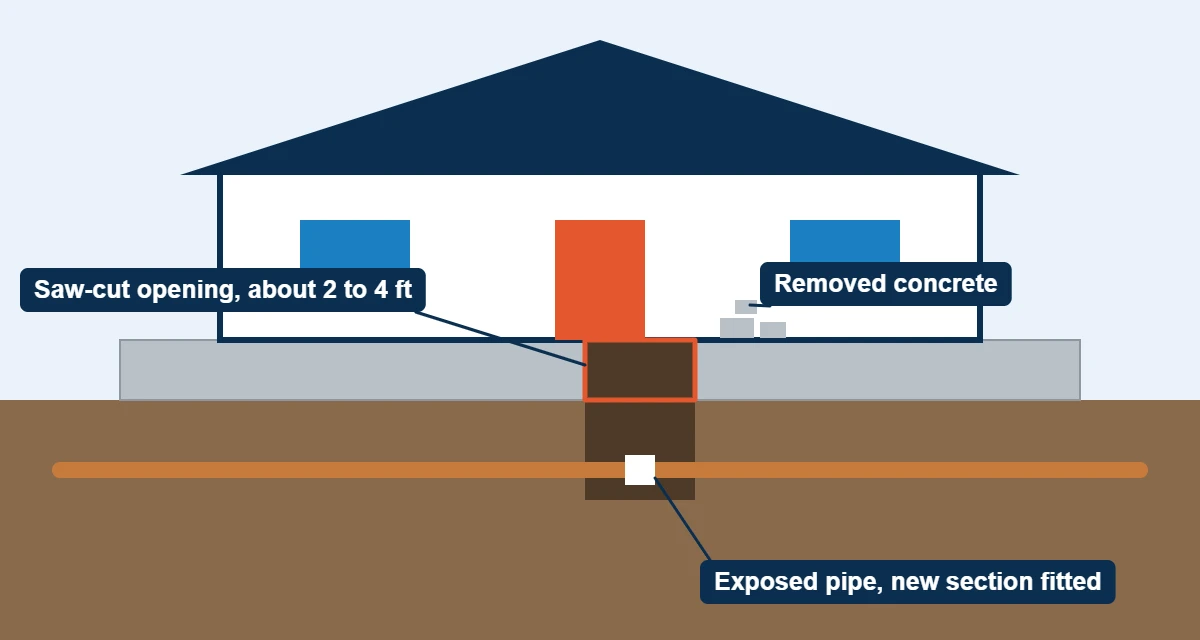
Decades ago, finding a slab leak meant jackhammering a trench across the room and hoping for the best. Modern acoustic listening and thermal imaging locate the break first, so the opening is typically just 2 to 4 feet square — big enough to work in, small enough to restore cleanly. If a company wants to break concrete before pinpointing the leak, that’s a red flag; detection should always come first.
How Does Slab Penetration and Concrete Restoration Work, Step by Step?
Here is the full sequence your technician follows — the standard approach for slab leak repair when opening the foundation is the right call:
- Mark the target. The located leak point is marked on the floor, with a margin for working room.
- Cut the concrete. A concrete saw scores the section — many pros use a wet saw to control dust.
- Remove the section. The cut piece is lifted out in chunks.
- Excavate. Soil is dug out to expose the pipe, usually 12 to 24 inches below the slab surface.
- Repair the pipe. The damaged section is cut out and replaced, or the line is capped for rerouting.
- Pressure-test. The fix is tested before anything is buried — this step is non-negotiable.
- Backfill and compact. Soil goes back in layers and is compacted so the slab won’t settle later.
- Re-pour concrete. Fresh concrete fills the opening, finished level with the existing slab.
- Cure. Concrete needs 24 to 72 hours to cure before flooring goes back down.
- Flooring restoration. Tile, wood, or carpet is reinstalled — see who handles this below.
How Big Is the Slab Penetration, Really?
| Situation | Typical opening | Why |
|---|---|---|
| Single pinpointed leak | 2 × 2 to 3 × 3 feet | Enough room to expose and repair one pipe section |
| Leak near a fitting or bend | 3 × 3 to 4 × 4 feet | Fittings need more working room |
| Multiple leaks in one area | Larger, or two openings | Each break needs its own access |
| Reroute instead of breakout | No slab opening at all | New pipe runs through walls or attic |
Depth is usually just the slab thickness (about 4 inches) plus digging down to the pipe — most residential water lines sit 12 to 24 inches under the slab surface.
Who Handles the Flooring Afterward?
Here’s the honest answer: most leak repair companies restore the concrete, but finish flooring — tile, hardwood, laminate, carpet — is often a separate trade. Some full-service companies handle both; many don’t.
Ask before work starts, in writing: “Is flooring removal and reinstallation included in your quote, or do I hire that separately?” Also ask who pays if a matching tile has been discontinued. The FTC’s advice on hiring home-improvement contractors — get everything in writing — applies here: consumer.ftc.gov
How Long Does Slab Penetration and Restoration Take, and What Does It Cost?
A straightforward spot repair through the slab often takes one day of work, plus 1 to 3 days of concrete curing before flooring goes back. National estimates as of 2026 put spot repair at $1,500–$4,500, which usually includes the concrete restoration but not always the finish flooring — confirm what’s included before you sign.
If leaks keep appearing in different spots, repeated breakouts stop making sense. At that point a whole-home repipe — new pipes routed through walls and attic, no slab cutting — is often the better long-term value.
What Can You Check Yourself Before Slab Penetration?
Before the crew arrives: move furniture at least 3 to 4 feet from the marked area, roll up rugs, photograph the flooring pattern (it helps with tile matching later), and make sure the crew knows where your main water shutoff is. Ask about dust control — concrete cutting is dusty work, and plastic sheeting over doorways helps.
Call Nova at (833) 542-3027 when you’ve confirmed leak signs and want our team to detect, open, repair, and restore. The line is open 24 hours a day, 7 days a week, and calling is free.
What Are the Limits of Slab Penetration?
- A restored concrete patch is structurally sound, but you may see the patch outline under hard flooring if the finish isn’t perfect — discuss finish expectations upfront.
- Post-tension slabs (with steel cables inside the concrete) must never be cut blindly — they need a specialist. See post-tension slab leak repair.
- Restoration fixes the opening, not the reason the pipe failed. Ask your pro what caused the leak so it doesn’t happen again in the next section of pipe.
Slab Penetration and Restoration: Frequently Asked Questions
Related Services
- Epoxy Lining vs Repiping: Two ways to fix failing pipes under your slab — here’s how to choose honestly.
- Post Tension Slab Leak Repair: Your slab may hold steel cables under high tension — here’s why that changes everything.
- Slab Leak Repair: Four proven ways to fix a leak under your slab — and how to pick the right one.
- Slab Leak Detection: How non-invasive detection finds a leak under concrete, with methods, cost and accuracy.
- Whole Home Repiping: When patching old pipes stops making sense, a full repipe ends the cycle.
Need Slab Penetration and Concrete Restoration? Call Nova Today
Call any time, day or night. Tell us your ZIP code and what you are noticing, and we will book your visit.