
Why Does Washington’s Ground Break Buried Pipes?
Washington ground stays wet for months. Puget Sound glacial till drains poorly. Winter rain keeps it soaked. Soaked soil swells and shifts. Shifting soil cracks joints. Volcanic soils east of the Cascades add rocky pressure. Our slab leak detection Washington technicians work this wet ground all season.
How Does Glacial Till Hold Water Against Pipes?
Glacial till packs clay, silt, and rock tight. Water cannot drain through it. Pipes in till sit in damp soil from fall through spring.
Damp soil moves. It swells in rains and settles in dry spells. That slow churn flexes pipe joints. Flexing wears copper at weak points.
Till hides leaks well. A drip vanishes in wet ground. The break can run for months. Bills climb while the cause stays buried.
What Do Volcanic Soils Add to the Problem?
East of the Cascades, volcanic soils rule. They run rocky and sharp. Stones press on pipe walls year after year. Thin spots form. Pinholes follow.
These areas freeze too. Cold snaps heave rocky ground. Heave lifts pipes and slabs. Lifted joints crack.
Watering adds a twist. Heavy summer watering soaks one side of a slab. One-sided soaking lifts in spots. That lift shears pipe joints.
Does the rain itself break pipes? No. But months of soaked till move. Moving soil breaks weak joints. Wet winters expose each weak spot.
What Are the Warning Signs of a Slab Leak in Washington?



Trust the meter first. Shut each tap inside and out. Watch the dial. A turning dial with taps off means a leak.
Indoor clues include:
- Warm patches on cold floors.
- Carpet that stays damp.
- Mold in just one room.
- Warped baseboards near the floor.
- The heater cycling too often.
- A faint hiss in a quiet house.
Outdoor signs mislead here. All looks wet in a local winter. A soggy yard proves nothing. Bills and warm floors tell the truth.
Dry damp spots fast to stop mold. Aim for 24 to 48 hours. The EPA mold guide outlines safe steps. Northwest damp grows mold fast.
Can a leak run all winter unseen? Yes. Constant rain masks surface signs. Meter tests still catch it. A dial that moves with taps off means flow.
Where Do We Serve in Washington?
We serve an expanding service area in Washington. Our technicians cover Puget Sound, the coast, and the east side. Some towns need booked slots.
We know the till country. We know the freeze zones. Look up your town on our locations page.
Who Should Call Nova in Washington?
Call if your home sits on Puget Sound till. This soil moves the most. Homes on it face the highest risk.
Call if your house dates past 25 years. Old copper plus years of wet winters thins out. Checks each few years spot pinholes early.
Call if you are buying. Wet-ground leaks hide in normal damp. Our gear finds them before closing day.
Call if you own rentals. Tenants miss warm floors. A yearly check beats a flooded unit.
Do you check crawlspace homes? Yes. Lots of homes here mix slabs and crawlspaces. We trace lines through both.
How Does a Nova Visit Work in Washington?
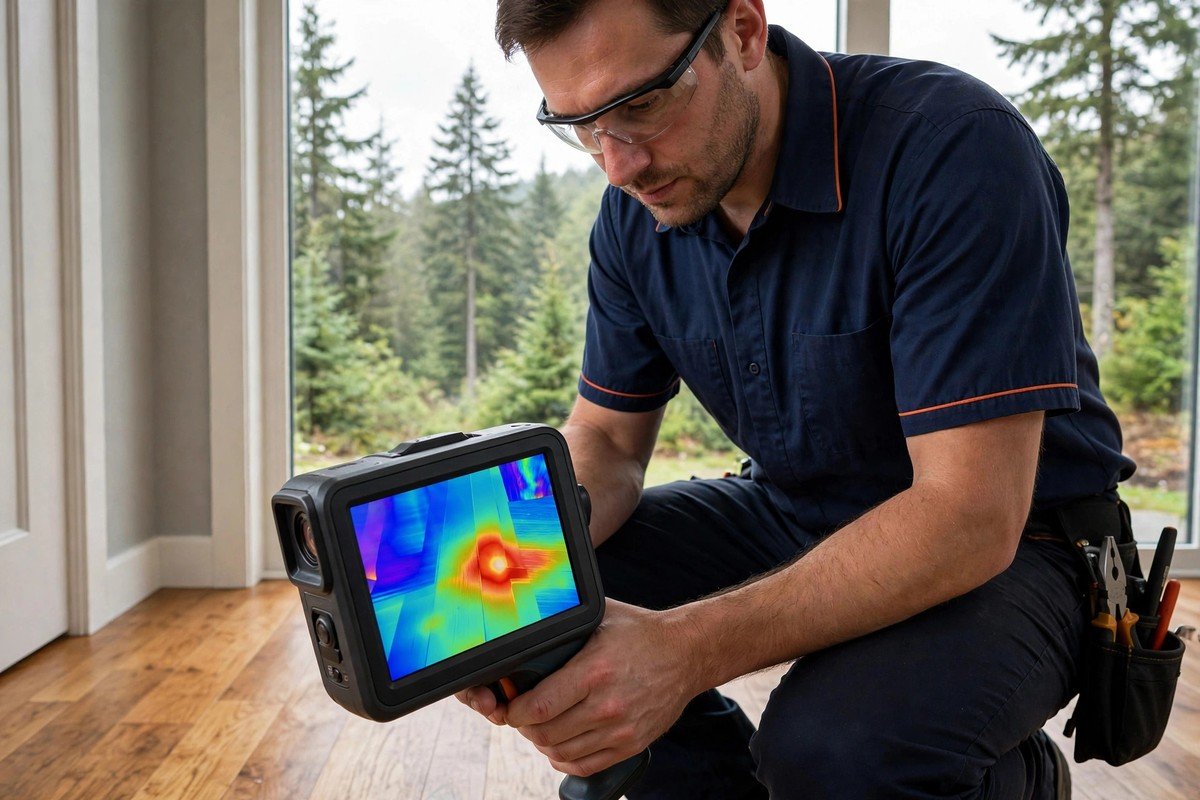
One of our own technicians runs your check. We show up with acoustic, thermal, and tracer gas tools. The same crew finds the leak and can fix it.
Here is the flow:
- Meter test. All water goes off. We watch the dial.
- Hot and cold lines get split-tested. The bad side shows fast.
- Acoustic gear traces the sound path. Heat scans back hot lines. Tracer gas finds cold-line breaks. We mark within 1–3 feet.
- You get a written plan and price. Nothing starts without your okay.
Checks take 1–3 hours. Soaked ground slows nothing. Our tools read through wet concrete. Detection never breaks the slab.
More on our process page.
What Does Detection Cost in Washington in 2026?
A leak check runs $150–$500. Complex homes reach about $600. These are national estimates as of 2026. Your technician confirms pricing first.
Repairs run higher. Nationally, spot repairs land at $1,500–$4,500. Reroutes run $3,500–$7,000. Tunneling runs $3,500–$8,000. Epoxy lining runs $3,000–$6,000. Whole-home repipes run $4,500–$15,000.
Wet till can slow repair digging. Reroutes through walls often win round Puget Sound. They skip the mud. Your technician prices all options for your home.
See our slab leak detection cost FAQ for price questions. Policies vary, so check your own plan for coverage.
How Do You Book a Visit in Washington?
Call (833) 542-3027. We answer 24/7, rain or shine. The call is free. We work in all weather. Rain never stops us.
Tell us what you see. We send one of our technicians. They call to set a time. East side or west side, one call starts it. Our technician takes it from there.
If our work is off, call us back. Our guarantee is simple. If our work is off, we set it right. You deal with Nova throughout.
FAQs
How fast can a technician come?
We take calls 24/7. Most checks book in a day or two. Active leaks jump the line.
Is a slab leak covered by insurance?
Policies vary. Many cover water damage but not the pipe fix. Read your policy and ask your agent.
Can detection hurt my flooring?
No. Our tools read through tile and concrete. Floors stay whole while we check.
How tight is the pinpoint?
We mark within 1–3 feet. Wet till does not blur our readings. A tight mark keeps fixes small.
Should old copper be patched or repiped?
With years of wet-ground wear, a repipe often wins. One patch on worn-out pipe invites the next break. Your technician can scope the run.
Do you reach eastern Washington?
We serve an expanding service area statewide. Our reach is broad. Check the town list on our locations page.