
Foundation Moisture Assessment and Water Intrusion Check
Find hidden moisture in and around your foundation before it turns into costly damage.
Foundation Moisture Assessment: Quick Answers
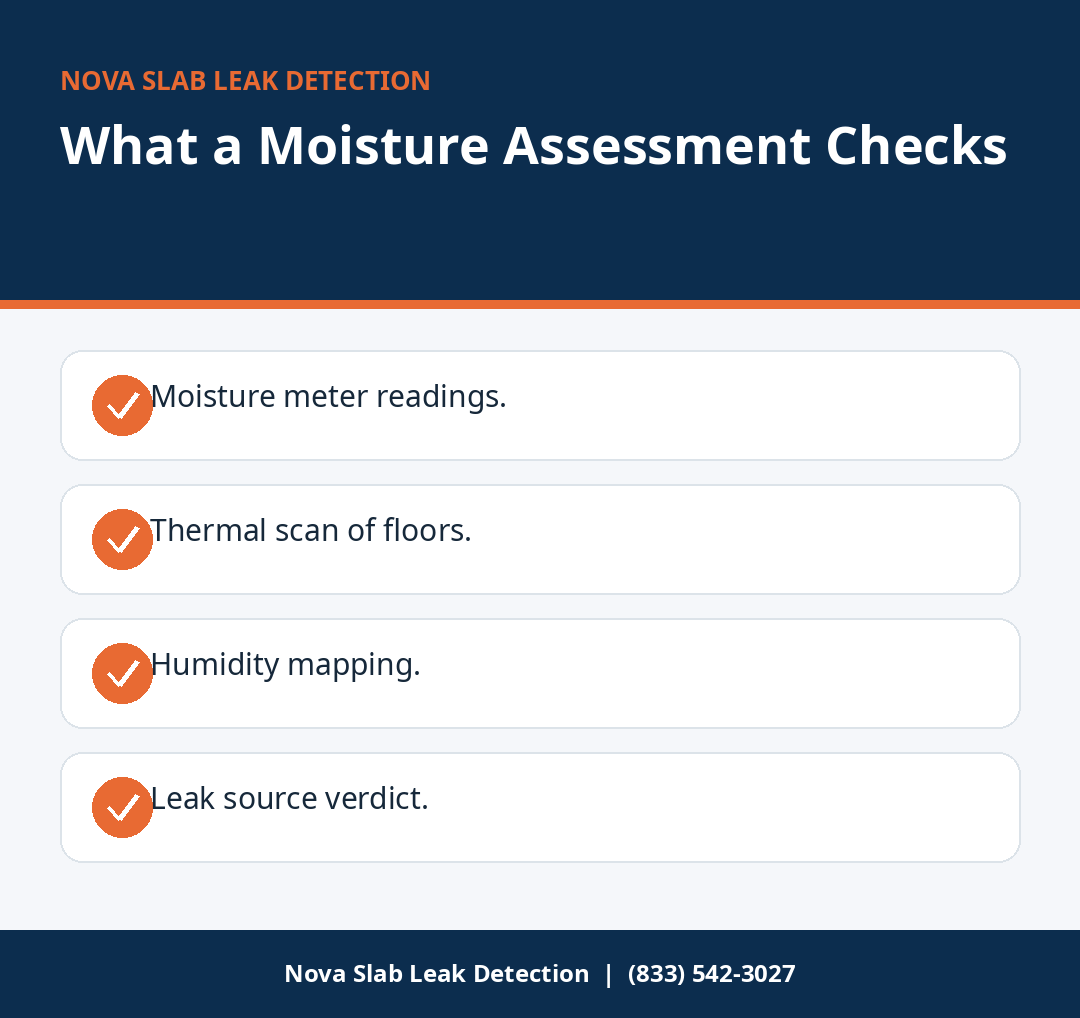
The short version of this guide to foundation moisture assessment:
- What Is a Foundation Moisture Assessment? A foundation moisture assessment is a professional inspection that finds hidden dampness in and around your home’s foundation.
- How Much Does a Foundation Moisture Assessment Cost, and How Long Does It Take? Nova’s own technicians carry out the work and give you the price before it starts.
- When Do You Need a Foundation Moisture Assessment? You are buying a home. The general inspection flagged dampness, staining, or a musty smell, and you want a specialist’s answer before you commit.
What Is a Foundation Moisture Assessment?
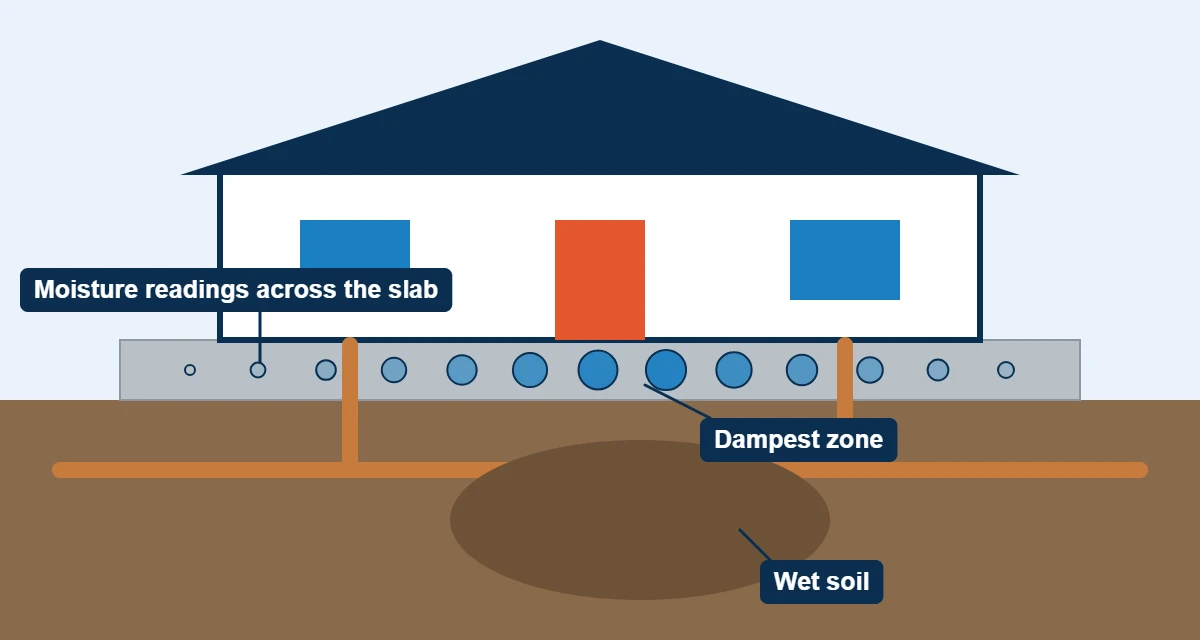
A foundation moisture assessment is a professional inspection that finds hidden dampness in and around your home’s foundation. It answers one question: where is water getting in, and how bad is it? The technician checks with moisture meters, looks for visible damage, reviews drainage around the house, and gives you a written report with findings and next steps.
A moisture assessment is different from a standard home inspection. A home inspector looks at the whole house in a few hours. A foundation moisture assessment goes deep on one problem only: water. The technician spends the visit tracing how water moves around your foundation, from the soil outside to the walls and slab inside.
It is also different from mold testing. The assessment finds the moisture that lets mold grow. It does not identify mold species or measure spores in the air. If the technician finds damp areas, the report will usually recommend drying the area promptly. The EPA advises to dry water-damaged areas within 24 to 48 hours to prevent mold.
The same Nova team that finds the leak explains your options and the price before any work begins. When you call, we send a technician who performs the assessment and gives you the price. Calling Nova is free. See all our services.
When Do You Need a Foundation Moisture Assessment?
You are buying a home. The general inspection flagged dampness, staining, or a musty smell, and you want a specialist’s answer before you commit. A moisture assessment gives you documented findings you can take back to the seller or use in negotiations.
You are selling a home. A pre-listing assessment finds moisture problems before a buyer’s inspector does. Fixing them early avoids price cuts, delayed closings, and deals that fall apart.
You see warning signs. Damp spots on walls or floors, white chalky mineral deposits (called efflorescence), peeling paint near the floor, or a musty smell that will not go away are all reasons to book one. Efflorescence means water is moving through your concrete and leaving minerals behind.
After heavy rain or flooding. Standing water near the foundation, a sump pump that ran for days, or a yard that stayed soggy can push moisture into places it never reached before. An assessment maps what got wet.
For insurance documentation. If you are filing or preparing a water-damage claim, a written professional report with moisture readings carries more weight than photos alone. Check your policy to see what documentation your insurer wants.
What Does the Pro Check, Step by Step?
A thorough assessment follows the water from outside in. Here is what usually happens during the visit:
- Interview. The technician asks when you first noticed the problem, whether it gets worse after rain, and what you have already tried. Your answers point them to the right areas.
- Exterior walk-around. They check the slope of the soil against the foundation (called grading), gutters, downspouts, and any spots where water pools near the house. Most foundation moisture starts outside.
- Interior visual inspection. They look at basement or crawlspace walls, the slab edge, baseboards, and flooring for staining, warping, efflorescence, and visible mold.
- Moisture meter readings. A moisture meter is a handheld tool with pins or a sensor pad that measures how much water is inside a material. The technician takes readings at many points to map where dampness is highest.
- Plumbing and appliance check. They look at nearby water heaters, washing machine hookups, and visible pipes, because a slow plumbing leak can look exactly like groundwater intrusion.
- Drainage review. They note where downspouts discharge, whether the yard slopes toward or away from the house, and any signs of past standing water.
The visit is non-invasive. Nothing gets cut open or torn out. If the findings point to a hidden pipe leak under the slab, the technician will usually recommend slab leak detection as the next step.
Foundation Moisture Assessment vs. Slab Leak Detection: What Is the Difference?
These two services get confused often. This table shows how they differ:
| Foundation moisture assessment | Slab leak detection | |
|---|---|---|
| Main question | Where is moisture coming from around the foundation? | Is there a leaking pipe under the concrete slab? |
| Suspected source | Groundwater, drainage, rain, humidity, or plumbing | Pressurized water or drain pipes under the slab |
| Main tools | Moisture meters, visual inspection, drainage review | Acoustic sensors, thermal cameras, tracer gas, pressure testing |
| Best when | Dampness, musty smells, staining, buying or selling | High water bill, sound of running water, warm floor spots |
| What you get | Written report mapping moisture and likely sources | Pinpointed leak location, usually within about 1 to 3 feet |
| Typical next step | Fix drainage, dry the area, or book leak detection | Repair the pipe: spot repair, reroute, or repipe |
Sometimes you need both. Moisture around a foundation can come from outside water and a leaking pipe at the same time. A good assessment tells you which problem you actually have so you do not pay for the wrong fix.
What Does Your Written Report Include?
Ask for the report in writing before the technician leaves. A useful report contains:
- A moisture map. Readings taken at each test point, showing which areas are dry, damp, and wet. Numbers beat opinions.
- Photos. Dated photos of every problem area, inside and outside.
- Likely sources. The technician’s judgment on where the water is coming from: grading, gutters, groundwater, plumbing, or a mix.
- Severity rating. Which areas need action now and which just need watching.
- Recommended next steps. Specific actions in priority order, such as extending downspouts, regrading soil, drying an area, or booking slab leak detection.
- Limits of the inspection. An honest report states what could not be checked, for example areas hidden behind finished walls. No inspection sees through concrete.
Keep this report. It is useful for insurance claims, contractor quotes, and real estate disclosures. If you sell the home later, it shows buyers you investigated the issue properly.

What Can You Check Yourself Before a Foundation Moisture Assessment?
You can gather useful clues in about 30 minutes. Do these checks, then share the results when you call:
- Walk the perimeter after rain. Look for puddles against the foundation, mulch washed away from the house, or soil that slopes toward the walls instead of away.
- Check downspouts. Every downspout should dump water at least 4 to 6 feet from the foundation. Short downspouts that end at the wall are one of the most common causes of foundation moisture.
- Look for efflorescence. White, chalky streaks on basement walls or the slab edge mean water has been moving through the concrete.
- Do the sniff test. Walk the lowest level of your home with the HVAC off. A musty or earthy smell points to hidden dampness even when everything looks dry.
- Check your water meter. Turn off every faucet and appliance, then watch the meter for 15 minutes. If it moves, water is escaping somewhere in your plumbing, which points toward a leak rather than groundwater.
Write down what you find. The technician will use your notes to focus the visit, which saves time.

How Much Does a Foundation Moisture Assessment Cost, and How Long Does It Take?
Nova’s own technicians carry out the work and give you the price before it starts. Prices vary by market and home size. When you call (833) 542-3027, ask what the assessment visit costs before you book, and ask what is included: the number of test points, photos, and whether you get a written report.
Most assessment visits take one to two hours for an average single-family home. Larger homes or properties with extensive dampness take longer. You will usually receive the written report within a day or two of the visit.
If the assessment finds signs of a pipe leak under the slab, the next step is professional detection. National estimates as of 2026 put slab leak detection at $150-$500, or up to about $600 for complex homes. Repair costs depend on the method: spot repair $1,500-$4,500, reroute $3,500-$7,000, tunneling $3,500-$8,000, epoxy lining $3,000-$6,000, and whole-home repipe $4,500-$15,000.
When Should You Call for a Foundation Moisture Assessment?
Call (833) 542-3027, open 24 hours a day, 7 days a week, when any of these apply:
- You see active water coming in, not just old stains. Active water cannot wait.
- Your own checks found multiple warning signs: pooling water, efflorescence, and musty smells together.
- You are buying or selling and need documented findings on a deadline.
- A previous inspection or contractor gave you conflicting answers and you want a second opinion focused only on moisture.
- The dampness keeps coming back after you fixed gutters or grading, which suggests the source is underground.
When you call, describe what you found in your self-checks. We will send a technician who performs assessments in your area.
Foundation Moisture Assessment: Frequently Asked Questions
Services Related to Foundation Moisture Assessment
These pages cover what comes before and after foundation moisture assessment.
- Sewer Line Leak Detection: Drain leaks hide under concrete too. Here’s how pros find and fix them.
- Slab Leak Repair: Four proven ways to fix a leak under your slab — and how to pick the right one.
- Water Line Leak Detection: How supply-line leaks are found and fixed without tearing up your whole home.
- Slab Leak Detection: How non-invasive detection finds a leak under concrete, with methods, cost and accuracy.
- All Slab Leak Services: Every detection and repair service, compared in one place.
Need a Foundation Moisture Assessment? Call Nova Today
Call any time, day or night. Tell us your ZIP code and what you are noticing, and we will book your visit for foundation moisture assessment.